wisemonkeys logo
FeedNotificationProfileManage Forms
FeedNotificationSearchSign in
wisemonkeys logo

Blogs

Cache memory

profile
Dhruv Punamiya
Jul 05, 2024
0 Likes
0 Discussions
82 Reads

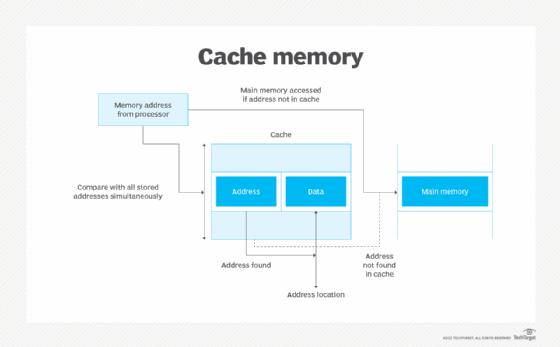
Cache memory is a small, high-speed storage located close to the CPU, designed to provide quick access to frequently used data and instructions. Acting as a bridge between the fast CPU and slower main memory, cache memory significantly boosts a computer's performance by reducing the time the CPU needs to wait for data.

There are typically three levels of cache memory: L1, L2, and L3. L1 cache is the smallest and fastest, embedded directly within the CPU chip, providing the quickest access to critical data. L2 cache is larger and slightly slower, often located on the same chip or a separate chip near the CPU. L3 cache is even larger and slower compared to L1 and L2 but is still faster than the main memory. It is usually shared among multiple CPU cores.

Cache memory operates on the principle of temporal and spatial locality. Temporal locality refers to the reuse of specific data within relatively short time intervals, while spatial locality refers to accessing data locations that are close to each other. By storing copies of frequently accessed data, cache memory minimizes the need to fetch data from the slower main memory.

The effectiveness of cache memory is measured by its hit rate, the percentage of memory accesses found in the cache. A high hit rate means the CPU spends less time waiting for data, leading to faster program execution. Modern processors employ sophisticated algorithms to manage cache content, deciding which data to keep and which to replace, ensuring optimal performance.

In summary, cache memory is a crucial component in modern computing, enhancing performance by providing rapid access to frequently used data. Its hierarchical structure, exploiting temporal and spatial locality, and advanced management algorithms make it indispensable for efficient CPU operations.


Comments ()


Sign in

Read Next

Types of Threads

Blog banner

c

Blog banner

India Digital Personal Data Protection Act, 2023

Blog banner

Simple Ways of Avoiding Basic Mistakes in Smart Phone Security

Blog banner

File management in os

Blog banner

How To Invest In Indian Stock Market @ BSE & NSE ~ Tutorial 3

Blog banner

Data Mapping

Blog banner

Why we should do reading

Blog banner

Tea, Coffee, Red Wine, and Teeth: A Stain Survival Guide

Blog banner

Article on Team Work

Blog banner

SPAM

Blog banner

Google

Blog banner

MEMORY MANAGEMENT REQUIREMENT

Blog banner

The War With Cold On Earth

Blog banner

The Evolution of Operating Systems

Blog banner

Synchronization

Blog banner

What is Email? Uses of Emails

Blog banner

Direct Memory Access

Blog banner

Deadlock

Blog banner

Multicore and Multithreading

Blog banner

Visualization in Data Science

Blog banner

38_Exploring The Honeynet Project

Blog banner

What is a Dumpster Diving Attack?

Blog banner

Python as a tool for data analysis

Blog banner

Odoo

Blog banner

Uniprocessor Scheduling

Blog banner

How International Schools Build Global-Minded Students through Curriculum & Activities

Blog banner

5 People who claimed to have Time Traveled

Blog banner

File Organization and Access

Blog banner

K-means use cases

Blog banner

Scheduling

Blog banner

SmartData Collective: Data Science aur Analytics ki Duniya

Blog banner

Memory management

Blog banner

Importance of self defence for girls

Blog banner

Types of Malware in Cyber Security

Blog banner

Memory Management

Blog banner

Bots and Cyber Security

Blog banner

Deadlock and starvation

Blog banner

A BLOG ON MYSQL

Blog banner

NETWORK SECURITY RISKS

Blog banner

How Running Changed My Life

Blog banner

Honeypot in cyber security

Blog banner