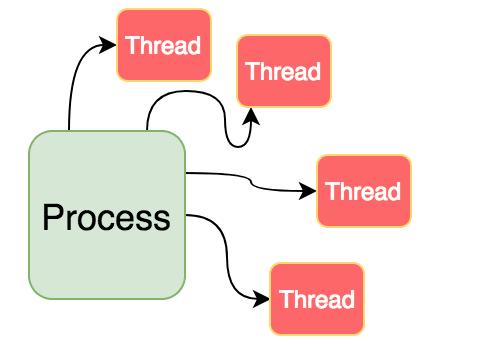
Linux threads, also known as Lightweight Processes (LWP), are the fundamental units of execution in the Linux operating system. Threads are similar to traditional processes, but they share the same address space, file descriptors, and other resources with other threads in the same process. In Linux, threads are implemented using the clone() system call, which creates a new thread within the same process.
**Key Points about Linux Threads:**
1. **Thread Creation:**Linux allows a process to create multiple threads using the clone() system call or the pthread_create() library function from the POSIX threads (pthreads) library.When a new thread is created, it starts execution from the specified entry point (function) and
shares the same memory space with other threads in the process.
2. **Shared Resources:** Threads in the same process share resources like global variables, open file descriptors, and other process-level data. This allows threads to communicate and synchronize with each other more efficiently compared to inter-process communication (IPC) mechanisms.
3. **Concurrency and Parallelism:** By having multiple threads within a process, Linux allows for concurrent execution of tasks, enabling better utilization of multi-core processors. When the system has multiple CPU cores, threads from the same process can execute in parallel, providing potential performance gains.
4. **Thread Synchronization:** Proper synchronization mechanisms like mutexes, semaphores, and condition variables are essential to coordinate access to shared resources and avoid data races between threads. These synchronization primitives are available through the pthreads library.
5. **Thread Management:** Threads in Linux are managed by the kernel scheduler, which determines the order in which threads are executed on the CPU cores. The scheduler follows various scheduling policies to distribute CPU time fairly among threads and processes.
6. **Thread Termination:** Threads can terminate either voluntarily or due to an error or signal. When a thread exits, its resources are released, and the exit status is available to the parent thread or process.
7. **User-level Threads vs. Kernel-level Threads:** Linux threads can be implemented either as user-level threads (ULTs) or kernel-level threads (KLTs). ULTs are managed entirely by the application's runtime library, while KLTs are directly managed by the kernel. In modern Linux,
threads are typically implemented as KLTs, which provides better performance and improved support for multi-core systems.
8. **Thread Attributes:** Threads can have various attributes, such as priority, scheduling policy, and stack size, which can be set during thread creation using the appropriate attributes structure.
Linux threads provide a flexible and efficient mechanism for concurrent programming in Linux- based systems. They are widely used in various applications, including multi-threaded servers, parallel computing, real-time systems, and more. Proper use of threads and synchronization is essential to avoid race conditions and ensure correct and efficient execution of multi-threaded programs.