wisemonkeys logo
FeedNotificationProfileManage Forms
FeedNotificationSearchSign in
wisemonkeys logo

Blogs

Memory Management

profile
Anam Maruf
Jul 04, 2024
0 Likes
2 Discussions
98 Reads


Memory management  helps to coordinate n control the computers main memory .

It ensures that  the memory space is properly managed and allocated in operating  system.

Memory managers enables sharing of memory space between processes. Hence  two programs can work  at the same memory location although at different times.


There are 3 types of memory management

Hardware memory management.

Operating system memory management.


Application memory management

Example :

If you have a computer of 8 gb of ram and want to run several programs then the memory management  helps to ensure that program have enough memory and cab run without interfering  with each other

Advantages:

It is a simple management approach

Disadvantages:

It does not support multiprogramming


In memory  management the memory unit supports two basic operations: read and write.

The read operation reads previously stored dat

The write operation stores a new value in memory. Both of these operations require a memory address. In addition, the write operation requires specification of the data to be written.

There are several types of computer memory such as random access memory (RAM), read-only memory (ROM), cache memory, virtual memory,

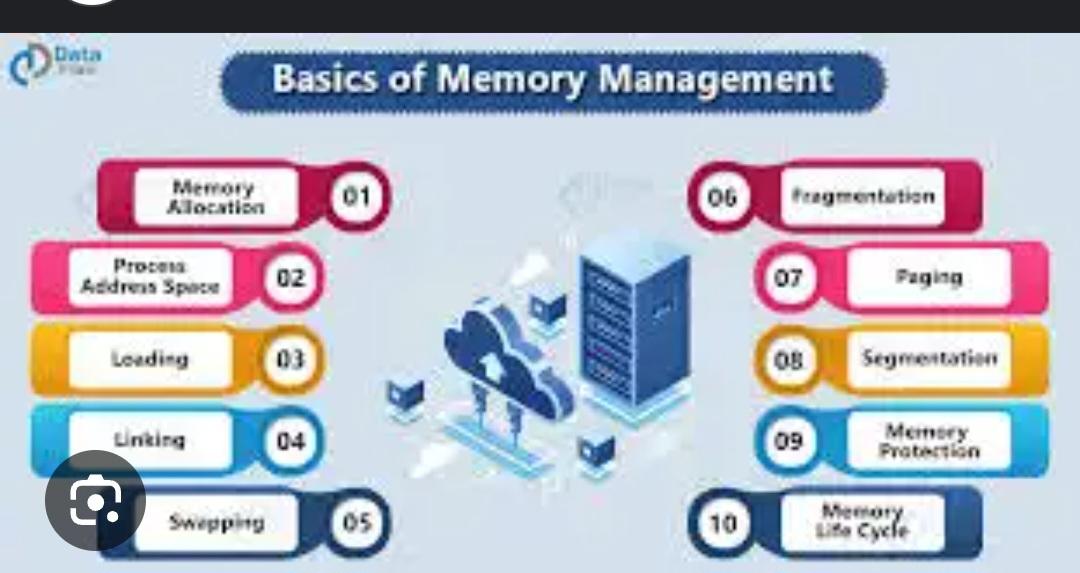
The main activities  of memory management  are


Thrashing

Memory protection

 Page replacement

Swapping

Demand pagging

Virtual memory

Segmentation

Paging

Memory  allocation

Etcc

Memoryy allocation has two typess 

They aree as follows:

Fixed Partitioning: Memory is divided into fixed-size partitions.


 Dynamic Partitioning: Memory is allocated to processes based on their needs

Page relapcement has following types:

FIFO (First-In-First-Out): Replaces the oldest page.


LRU (Least Recently Used): Replaces the page that has not been used for the longest time.


Optimal: Replaces the page that will not be used for the longest time in the future

Basic Functions of Memory Management

Tracking each byte of memory in the system.


Allocating and deallocating memory spaces as needed by the system's processes.


Managing swap spaces, which store inactive pages of memory.


Implementing policies for memory allocation.

Anam Maruf 

Div-A 

53003230032



Comments ()


Sign in

Read Next

MODERN OPERATING SYSTEM

Blog banner

Developments in Modern Operating Systems

Blog banner

S-Tool : Steganography

Blog banner

Understanding E-mail Servers

Blog banner

Introduction to Virtual Memory - 080

Blog banner

I/O buffer and its techniques

Blog banner

bulk email software

Blog banner

CYBERPEACEKEEPING: NEW WAYS TO PREVENT AND MANAGE CYBERATTACKS

Blog banner

Crypto tax evasion

Blog banner

PPT methodology

Blog banner

PROCESS STATE:

Blog banner

The New Classic: Indo Western Patola Outfits for Today’s Woman

Blog banner

Worms, viruses and Bots

Blog banner

Human factor, a critical weak point in the information security of an organization’s IOT

Blog banner

Elements and Principles of Photography

Blog banner

Mental Health

Blog banner

Banaras

Blog banner

Article on IT development trends

Blog banner

UniProcessor Scheduling

Blog banner

21ST CENTURY PATRIARCHY

Blog banner

Junk food vs healthy food

Blog banner

OS Assignment-3

Blog banner

KASHMIR TRIPS

Blog banner

Teamwork

Blog banner

Title: Network Sniffing Techniques: Uncovering the Secrets of Data Transfer

Blog banner

Memory Management

Blog banner

Caching windows

Blog banner

The Evolution of the Microprocessor ~ Aditya Pai

Blog banner

How College Events Build Real-world Skills You Can’t Learn From Textbooks

Blog banner

How Do I Get Rid of My People-Pleasing Behaviour?

Blog banner

Privacy-Enhancing Computation Techniques

Blog banner

PROCESS CONTROL BLOCK IN OS

Blog banner

MEMORY MANAGEMENT FILE

Blog banner

Danger assessment in GIS

Blog banner

File management

Blog banner

INTERNET SECURITY

Blog banner

Memory management

Blog banner

Data Acquisition in Cyber Forensics

Blog banner

Difference Between Classification And Clustering

Blog banner

objectives and function of operating system

Blog banner

Krishna Rao SAP ID--53003230076

Blog banner

Optimization of operating system design

Blog banner