wisemonkeys logo
FeedNotificationProfileManage Forms
FeedNotificationSearchSign in
wisemonkeys logo

Blogs

Virtual memory

profile
Anam Maruf
Aug 13, 2024
0 Likes
0 Discussions
93 Reads

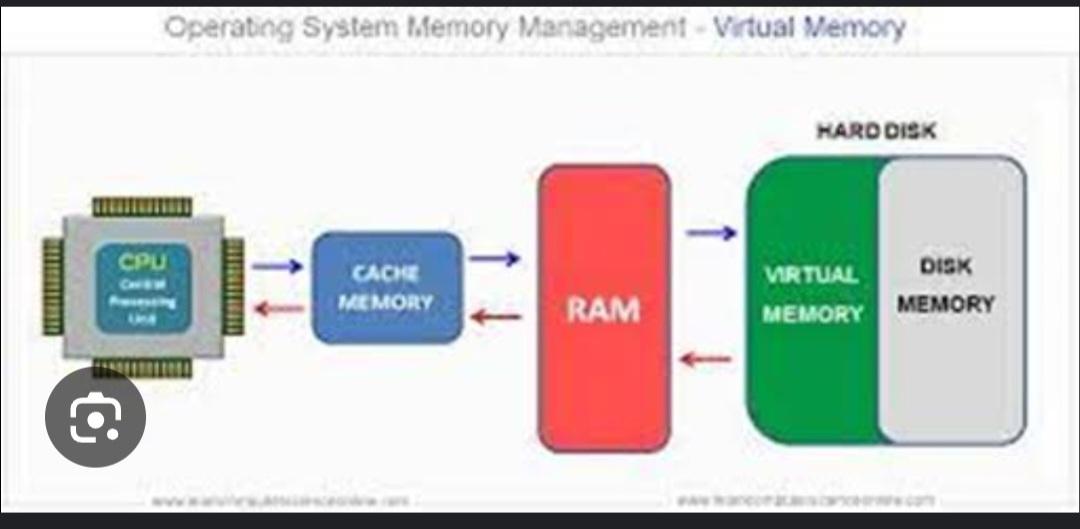
Virtual memory is a memory management technique used by operating systems to give the appearance of a large, continuous block of memory to applications, even if the physical memory (RAM) is limited. It allows the system to compensate for physical memory shortages, enabling larger applications to run on systems with less RAM.

It is a technique that is implemented using both hardware and software. It maps memory addresses used by a program, called virtual addresses, into physical addresses in computer memory. 

  • All memory references within a process are logical addresses that are dynamically translated into physical address at run time. This means that a process can be swapped in and out of the main memory such that it occupies different places in the main memory at different times during the course of execution.
  • There are two main types of virtual memory:

    • Paging
    • Segmentation
    • Paging divides memory into small fixed-size blocks called pages. When the computer runs out of RAM, pages that aren’t currently in use are moved to the hard drive, into an area called a swap file. The swap file acts as an extension of RAM. When a page is needed again, it is swapped back into RAM, a process known as page swapping. This ensures that the operating system (OS) and applications have enough memory to run

    •  

      Segmentation divides virtual memory into segments of different sizes. Segments that aren’t currently needed can be moved to the hard drive. The system uses a segment table to keep track of each segment’s status, including whether it’s in memory, if it’s been modified, and its physical address. Segments are mapped into a process’s address space only when needed.


Comments ()


Sign in

Read Next

How Reading Books Shape a Child’s Imagination and Thinking?

Blog banner

HubSpot

Blog banner

Modern Operating System

Blog banner

E-BUSINESS RISK MANAGEMENT

Blog banner

THE INPACT OF SOCIAL MEDIA!

Blog banner

Raid

Blog banner

Memory hierarchy

Blog banner

The Evolution of Operating Systems

Blog banner

Process, process creation and process termination

Blog banner

25 Movies to Watch Post Breakup Blues

Blog banner

MEMORY MANAGEMENT FILE

Blog banner

Impact of social media on the human life

Blog banner

Bharat Maps

Blog banner

Install Ubuntu in Vmware

Blog banner

c

Blog banner

What is Influencer Marketing and its Trends

Blog banner

Life of an army person

Blog banner

The launch of UniMap by HERE

Blog banner

Why Oak Tree Hotel Is Arcadia’s Hidden Gem?

Blog banner

Memory Management

Blog banner

Rain bow

Blog banner

How Social Media Algorithms Will Work in 2026?

Blog banner

Privacy-Enhancing Computation Techniques

Blog banner

Biometric Authentication and Privacy: Balancing Ethical Concerns

Blog banner

21ST CENTURY PATRIARCHY

Blog banner

internet email and it's applications

Blog banner

History of ITIL

Blog banner

Disk Management

Blog banner

Risk factors in service transistion

Blog banner

Note on Process, Process creation and Process termination

Blog banner

ITIL Version 3 and 4 differenciation?

Blog banner

Rules and Regulations of Networking: "Standards and Protocols" - Part 1

Blog banner

Nature’s Brush on Silk: The Secret Behind Patola Colours

Blog banner

ONLINE NEWSROOMS

Blog banner

How to Prepare Your Child for Their First Day of School?

Blog banner

Use case of K-means clustering

Blog banner

Memory Management in an Operating System

Blog banner

How to Encrypt and Decrypt Using GNU PGP

Blog banner

KASHMIR TRIPS

Blog banner

Shoulders

Blog banner

LTE Technology

Blog banner

Starvation and Deadlock.

Blog banner