wisemonkeys logo
FeedNotificationProfileManage Forms
FeedNotificationSearchSign in
wisemonkeys logo

Blogs

All you need to know about Cassandra

profile
SANTOSH RAJBHAR
Oct 08, 2023
0 Likes
0 Discussions
143 Reads

Data Model:

  • Cassandra is a NoSQL database well-suited for handling semi-structured or unstructured data.
  • It uses a wide-column store data model, which allows for a flexible schema desig
  • Scalability:

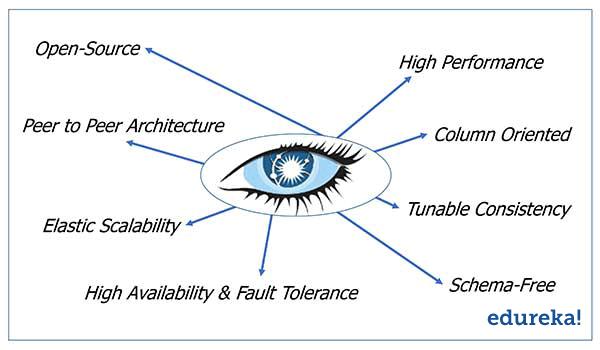
    • Cassandra is known for its horizontal scalability. It can quickly scale out by adding more nodes to a cluster to accommodate growing data volumes and user loads.
  • Performance:

    • Cassandra offers high write throughput and low-latency reads, making it suitable for applications requiring fast data ingestion and retrieval.
    • It is optimized for write-heavy workloads.
  • Consistency vs. Availability vs. Partition Tolerance (CAP):

    • Cassandra follows the CAP theorem and prioritizes both availability and partition tolerance over strong consistency.
    • It offers tunable consistency levels, allowing you to configure the level of consistency according to your application's needs.
  • Data Volume:

    • Cassandra is designed to handle large datasets efficiently, making it a good choice for applications with significant data volumes.
  • Complexity of Queries:

    • Cassandra is proficient at handling simple queries and lookups by key.
    • Complex queries may require denormalization or the use of additional tools like Apache Spark or Elasticsearch for analytics.
  • Consistency Models:

    • Cassandra supports tunable consistency, allowing you to choose the desired level of character (e.g., eventual consistency or stronger consistency) for each query.
  • Security and Compliance:

    • Cassandra provides security features like authentication, authorization, and encryption to protect your data.
    • Ensure that it meets your application's security and compliance requirements.
  • Cost and Licensing:

    • Cassandra is open source and free to use. However, there may be costs associated with infrastructure, support, and additional tools.
  • Backup and Disaster Recovery:

    • Cassandra offers features for backup and recovery to ensure data integrity and availability in case of failures.
  • Future Growth and Flexibility:

    • Cassandra's horizontal scalability and flexible data model make it suitable for applications with growth potential and changing requirements.
  • Data Integrity and ACID Transactions:

    • Cassandra provides limited support for ACID transactions and is primarily designed for eventual consistency and high availability rather than strong consistency.
  • Latency and Geographic Distribution:

    • Cassandra supports multi-datacenter replication, allowing data to be distributed across multiple geographic regions to minimize latency and improve availability.
  • Operational Complexity:

    • Managing Cassandra clusters can be complex, requiring expertise in deployment, configuration, and monitoring. Consider using managed Cassandra services or consulting services for smoother operations
  • Development Ecosystem and Support:

    • Cassandra has a well-established ecosystem with libraries, drivers, and tools available for various programming languages.
    • It benefits from a strong open-source community and vendor support from companies like DataSta
    •  

Comments ()


Sign in

Read Next

Cloud Security: Trends and Innovations

Blog banner

Fitness

Blog banner

Service Strategy In ITSM

Blog banner

Mariana Trench: The deepest depths

Blog banner

DBMS and various career options related to it.

Blog banner

Explain website hacking issues

Blog banner

Multicore and multithreading 171

Blog banner

Threading

Blog banner

MODERN OPERATING SYSTEMS

Blog banner

" THE ANSWERS THAT LED INDIAN BEAUTIES TO THE MISS UNIVERSE HISTORIC WIN. "

Blog banner

What Is Experiential Learning and Why Does It Work Better Than Rote Learning?

Blog banner

Sweet Mango Murabba

Blog banner

Riddhi Miyani 53003220140

Blog banner

Memory Management

Blog banner

Tracking Emails & Email Crimes

Blog banner

Explain DBMS in Brief

Blog banner

What is Email? Uses of Emails

Blog banner

The Role of Frontline Managers in Driving Workplace Performance and Customer Satisfaction

Blog banner

Service Design Principles

Blog banner

Pink sauce pasta

Blog banner

Buffer Overflow

Blog banner

Paralysis/Paralysis Stroke

Blog banner

Power of words

Blog banner

Everything You Need for a Perfect Stay in Arcadia, Florida, USA.

Blog banner

Android Application Components and Activity Lifecycle

Blog banner

Security in Cloud Computing

Blog banner

Travelling blog

Blog banner

A Statistical Analysis of Player Performance and their Value in cricket

Blog banner

Metasploit

Blog banner

History of Money

Blog banner

File management

Blog banner

Hypothesis Testing in Data Science

Blog banner

What's Better : Supervised or Unsupervised Learning

Blog banner

Deadlock and Starvation

Blog banner

Fault Tolerance in an Operating System

Blog banner

Constrained Management in IT

Blog banner

Constrains in service design

Blog banner

Daycare Centres Help Children Transition into Structured Learning

Blog banner

Product Discount Calculator

Blog banner

File management

Blog banner

E-security systems | CCTV

Blog banner

Understanding Regression Analysis

Blog banner