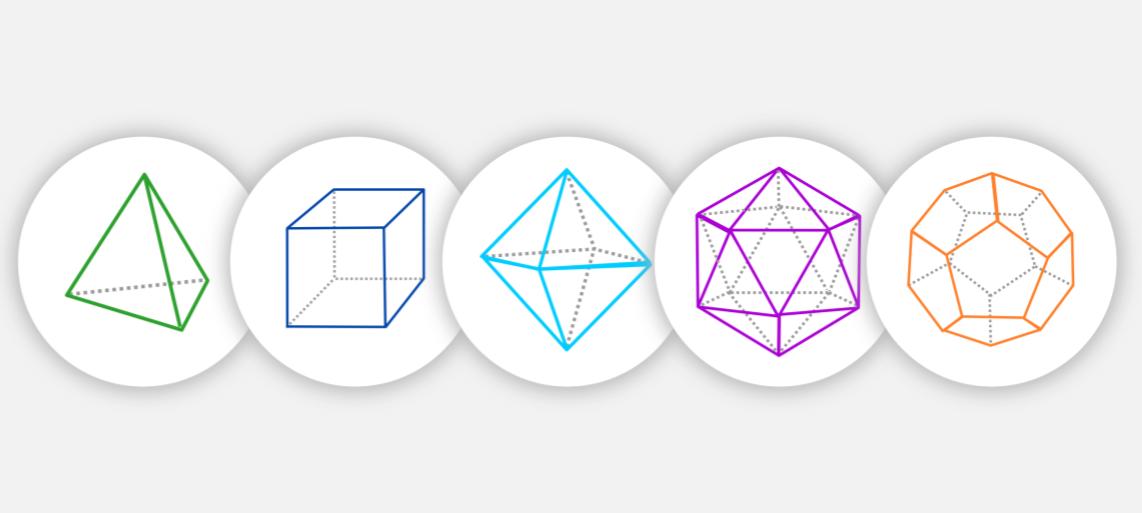
🔹 What are Platonic Solids?
A Polyhedron is a solid with flat faces. The word is derived from Greek poly- meaning "many" and -edron meaning "face".
A Platonic Solid is special type of polyhedron where
each face is the same regular polygon and
the same number of faces meet at each vertex
The Greek philosopher Plato (https://en.wikipedia.org/wiki/Plato), who was born around 430 B.C., wrote about these five solids in a work called Timaeus. He associated each of the five elements (earth, air, water, fire and ether) with a platonic solid.
Following are the five platonic solids -
1) TETRAHEDRON
Faces: 4 equilateral triangles
Edges: 6
Vertices: 4
Element associated: Earth 🌏
2) CUBE
Faces: 6 squares
Edges: 12
Vertices: 8
Element associated: Water 🌊
3) OCTAHEDRON
Faces: 8 equilateral triangles
Edges: 12
Vertices: 6
Element associated: Air 💨
4) DODECAHEDRON
Faces: 12 regular pentagons
Edges: 30
Vertices: 20
Element associated: Fire 🔥
5) ICOSAHEDRON
Faces: 20 equilateral triangles
Edges: 30
Vertices: 12
Element associated: Ether 🌀
Where do you find these solids in real life? 🌳🧬
These polyhedra are everywhere. The tetrahedron, cube, and octahedron all occur naturally in crystal structures.
Many viruses, such as the herpes virus, have the shape of a regular icosahedron. Viral structures are built of repeated identical protein subunits and the icosahedron is the easiest shape to assemble using these subunits.