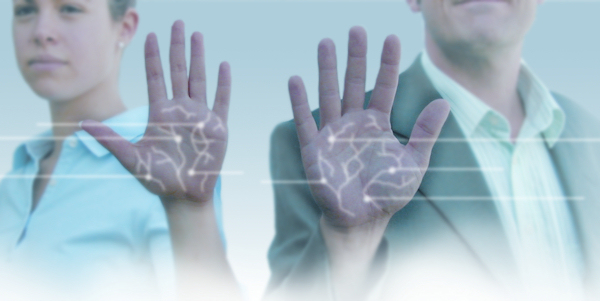
Palm vein recognition technology is one of the
biometric technologies most widely accepted by patients and healthcare providers because it identifies patients with a high level of accuracy, and is easy for patients to use and accept.

While other types of biometric scanners are more popular for security systems, Vascular scanners are growing in popularity. Fingerprint scanners are more frequently used, but Naito says they generally do not provide enough data points for critical verification decisions. Since fingerprint scanners require direct contact of the finger with the scanner, dry or abraded skin can interfere with the reliability of the system.
Biometrics is gaining more and more popularity in the financial services industry worldwide. In fact, the biometrics market is expected to reach a value of $30 billion by 2021. The technology is claimed to be the most convenient method as users don’t have to remember the numbers, codes or passwords.

Seeking to leverage the technology, a range of banks have turned to testing biometrics on limited audiences/particular markets. It may not take long till the industry makes biometric authentication a mainstream and ditches passwords once and forever.
Fujitsu provides a highly reliable biometric authentication system based on palm vein pattern recognition technology.
PalmSecure is claimed to feature industry-leading authentication accuracy with extremely
low false rates, and the
non-intrusive and
contactless reader device provides ease of use with virtually no physiological restriction for all users. Devices can be applied for physical access control, time and attendance track, user authentication for PCs or servers, government / commercial identity management systems and more.
Working

1.One should place his/her palm near to scanner
2.The scanner makes use of a special characteristic of the reduced hemoglobin coursing through the palm veins it absorbs near-infrared light. This makes it possible to take a snapshot of what's beneath the outer skin, something very hard to read or steal.
3.The integrated optical system in the palm vein sensor uses this phenomenon to generate an image of the palm vein pattern and the generated image is digitized, encrypted and finally stored as a registered template in the database.
Comparing Fingerprint Recognition and Palm Vein Technology
Personal identification technology is increasingly becoming important in security systems. The key advantages of using biometrics technology are non-repudiation, not guessable, not forgettable and availability.
There are many traits such as
fingerprint, retina, iris, vein etc. that can be used as biometric identifiers to authenticate individuals. However, two of the most popular biometric modalities are fingerprint recognition and palm vein recognition. Both fingerprint and palm vein recognition are physiological modalities which mean they are related to the shape of the body.
The first type of biometric identifier is fingerprint recognition, which uses a highly sensitive camera to capture the thumb prints of individuals.
The other kind of biometric trait, palm vein technology, uses an infrared sensor which is used to identify an individual’s vein pattern.

What happens if the registered palm gets damaged?
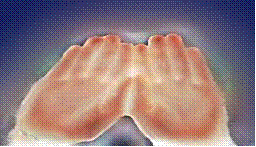
There may be a chance that the palm we had registered may get damaged then we cannot use this technology, so during the time of registration we take the veins of both the hands so that if one gets damaged we can access through the second hand. When hand get damaged up to large extent we can get veins because deeper into the hand veins are obtained. When we apply this method we can maintain complete privacy .
How Secure is the Technology?
On the basis of testing the technology on more than
70,000 individuals , Fujitsu declared that the new system had a false rejection rate of
0.01% (i.e., only one out of 10,000 scans were incorrect denials for access), and a false acceptance rate of less than
0.00008% (i.e., incorrect approval for access in one in over a million scans). Also, if your profile is registered with your right hand, don't log in with your left - the patterns of an individual's two hands differ. And if you registered your profile as a child , it'll still be recognized as you grow, as an individual's patterns of veins are established in utero (before birth). No two people in the world share a palm vein pattern - even those of identical twins differ . In addition the devices ability to perform personal authentication was verified using the following:
1. Data from people ranging from 6 to 85 years old including people in various occupations in accordance with the demographics realized by the Statistics Center of the Statistics Bureau.
2. Data about foreigners living in Japan in accordance with the world demographics released by the united nations.
3. Data taken in various situations in daily life including gafter drinking alcohol, taking a bath, going outside and waking up.
Applications
- Passports
- Banks
- Personal computer and laptops
- Hospitals
- Home Appliances
- Libraries
- Laboratories
- ATM's
Advantages
- Most secure
- Economical
- Cheap to produce, fast and small
- Easy to install
- One time registry