wisemonkeys logo
FeedNotificationProfileManage Forms
FeedNotificationSearchSign in
wisemonkeys logo

Blogs

Memory hierarchy

profile
Kush Patel
Jul 05, 2024
0 Likes
0 Discussions
82 Reads

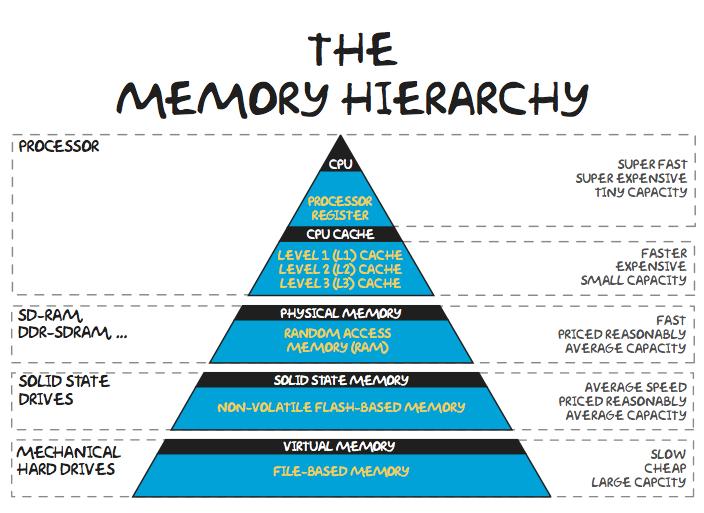
Main memory, alternatively RAM (Random Access Memory), is a cache that is following. Though slower, it is significantly larger than both cache and registers. It acts as an expanded storage space for the current data and active processes. Ram has a quick reading and writing speed than the secondary memory because it is volatile meaning it loses stored information when power goes off.

Secondary storage implies disks (e.g., hard disk drives (HDDs) or solid-state drives (SSDs)) such as HDDs and SSDs. These devices are non-volatile; they retain data even after power has been switched off while costing less per bit of information saved compared to RAM in terms of capacity. They are however much slower which makes them not very useful for direct data retrieval by the CPU during active tasks. Secondary storage is best suited to long-term storage for operating systems, applications, and large files.

The principle of memory hierarchy constitutes the central element of computer architecture and is grounded on the length of processing, size, and costs. There are strategies of using this hierarchy in a most effective way, such as data caching, memory management, and the application of algorithms that help the computer to go to the necessary memory layers faster that include the CPU cache and then main memory. With the help of additional memory chips, so-called cache that holds frequently accessed data, it will become possible for the computer to offload secondary data from vast yet inexpensive storage unit to a slower one and so can it ensure both high speeding retrieval of data and high data-handling functionality.

Ensuring a well-organized memory hierarchy is a fundamental key to system architects, developers, and engineers who are striving to make the computational operations more efficient and overall system performance more effective.

Div:A

Kush Patel 

53003230107


Comments ()


Sign in

Read Next

The Evolution of Operating Systems

Blog banner

MAJOR ACHIEVEMENTS OF OS

Blog banner

Virtual Memory

Blog banner

SEIZING DIGITL EVIDENCE AT THE SCENE

Blog banner

RAID - LEVELS OF RAID

Blog banner

Data Mining

Blog banner

Bit Coins

Blog banner

Dr. Venkadavarahan

Blog banner

Fault Tolerance

Blog banner

Social Media.

Blog banner

Privacy-Enhancing Computation Techniques

Blog banner

Is it important to follow all the trends that come up on social media?

Blog banner

BLOCKCHAIN MACHANISM

Blog banner

Fault Tolerance in an Operating System

Blog banner

Smartphone Security: Vulnerabilities and Attacks

Blog banner

What are the different types of E-mail crime and process of email forensic?

Blog banner

What is Brute Force Attack? How to defend against it?

Blog banner

File Management In OS

Blog banner

DNS Cache

Blog banner

Deadlock

Blog banner

Paging

Blog banner

Google classroom

Blog banner

Modern Operating System

Blog banner

Atlantis - The Lost Island.........

Blog banner

SECURITY VULNERABILITIES COUNTERMEASURES IN A SMART SHIP SYSTEM

Blog banner

OS Assignment-3

Blog banner

TRAIN TRAVELING

Blog banner

Deadlock Prevention

Blog banner

Disk cache

Blog banner

Bulk E-mail software

Blog banner

What is time ? The term which has astonished Scientists

Blog banner

Types of Hackers

Blog banner

Twisted world

Blog banner

The New Dr. Frankenstein who will perform first full head transplant

Blog banner

Multiprocessor and Multicore Organization

Blog banner

All you need to know about “Off-page SEO”

Blog banner

Memory Management in Operating System

Blog banner

Busted : Common Web Security Myths

Blog banner

Operating system evolution

Blog banner

Cyber Attacks -- Trends Patterns and Security Countermeasures

Blog banner

Mumbai Metro 3

Blog banner

Know your Processors!

Blog banner