- A vulnerability assessment is the process of defining, identifying, classifying and prioritizing vulnerabilities in computer systems, applications, and network infrastructures.
- Vulnerability assessments also provide an organization with the necessary knowledge, awareness and risk backgrounds to understand and react to threats to its environment.
- A vulnerability assessment process is intended to identify threats and the risks they pose. They typically involve the use of automated testing tools, such as network security scanners, whose results are listed in a vulnerability assessment report.
- A vulnerability assessment provides an organization with details on any security weaknesses in its environment. It also provides direction on how to assess the risks associated with those weaknesses. This process offers the organization a better understanding of its assets, security flaws, and overall risk, reducing the likelihood that a cybercriminal will breach its systems and catch the business off guard.
1. Goals and Objective: Define the goals and objectives of Vulnerability Analysis.
2. Scope: While performing the Assessment and Test, the assignment's Scope needs to be clearly defined. The following are the three possible scopes that exist, such as:
- Black Box Testing: It is a software testing method in which software applications' functionalities are tested without knowing the internal code structure, implementation details, and internal paths.
Black Box Testing mainly focuses on the input and output of software applications, and it is entirely based on software requirements and specifications. It is also known as Behavioral Testing.
- White Box Testing: White box testing is a software testing technique in which internal structure, design and coding of software are tested to verify the flow of input-output and also improve design, usability and security.
In white-box testing, code is visible to testers, so it is also called Clear box testing, Open box testing, transparent box testing, Code-based testing, and Glass box testing.
- Grey Box Testing: It is a software testing technique to test a software product or application with partial knowledge of its internal structure. The purpose of grey box testing is to search and identify the defects due to improper code structure or improper applications.
In this process, context-specific errors that are related to web systems are commonly identified. It increases the testing coverage by concentrating on all of the layers of any complex system
3. Information Gathering: Obtaining as much information about the IT environment, such as Networks, IP Address, Operating System Version, etc. It applies to all three types of Scopes, such as Black Box Testing, White Box Testing, and Grey Box Testing.
4. Vulnerability Detection: In this step, vulnerability scanners scan the IT environment and identify the vulnerabilities.
5. Information Analysis and Planning: It will analyze the identified vulnerabilities to devise a plan for penetrating the network and systems
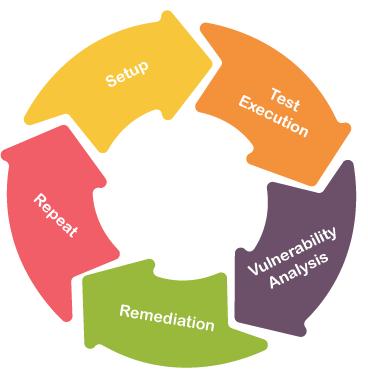
Step 1) Setup: We need to start by determining which systems and networks will be assessed, identifying where any sensitive data resides, and which data and systems are most critical. Configure and update the tools.
Step 2) Test Execution: A packet is the data routed unit between an origin and the destination. When any file, such as an e-mail message, HTML file, Uniform Resource Locator (URL) request is sent from one place to another on the internet, the TCP layer of TCP/IP divides the file into several "chunks" for efficient routing. Each of these chunks will be uniquely numbered and will include the Internet address of the destination. These chunks are called packets
Step 3) Vulnerability Analysis: Now define and classify network or System resources and assign priority to the resources (low, medium, high). Identify potential threats to each resource and develop a strategy to deal with the most prioritized problems. Define and implement ways to minimize the consequences if an attack occurs.
Step 4) Remediation: The vulnerability assessment results to patch key flaws or problems, whether simply via a product update or through something more involved, from installing new security tools to an enhancement of security procedures.
Step 5) Repeat: Vulnerability assessments need to be conducted regularly, monthly or weekly, as any single assessment is only a report of that moment in time. These reports give a strong sense of how security posture has developed.