wisemonkeys logo
FeedNotificationProfileManage Forms
FeedNotificationSearchSign in
wisemonkeys logo

Blogs

Big Data Architecture

profile
Jermin Shaikh
Mar 14, 2022
0 Likes
0 Discussions
141 Reads

What is Big Data Architecture?

  • This architecture is designed in such a way that it handles the ingestion process, processing of data, and analysis of the data is done which is way too large or complex to handle the traditional database management systems.
  • Different organizations have different thresholds for their organizations, some have it for a few hundred gigabytes while for others even some terabytes are not good enough a threshold value.
  • Due to this event happening if you look at the commodity systems and the commodity storage the values and the cost of storage have reduced significantly. There is a huge variety of data that demands different ways to be catered.
  • Some of them are batch-related data that comes at a particular time and therefore the jobs are required to be scheduled similarly while some others belong to the streaming class where a real-time streaming pipeline has to be built to cater to all the requirements. All these challenges are solved by big data architecture.

Explanation of Big Data Architecture

Big Data Architecture Systems


Big Data systems involve more than one workload type and they are broadly classified as follows:

  1. Where the big data-based sources are at rest batch processing is involved.
  2. Big data processing is in motion for real-time processing.
  3. Exploration of interactive big data tools and technologies.
  4. Machine learning and predictive analysis.

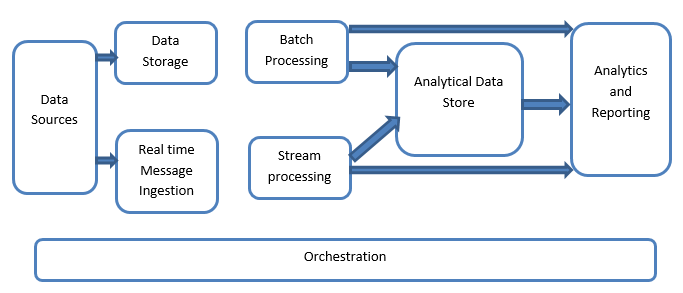
1. Data Sources

The data sources involve all those golden sources from where the data extraction pipeline is built and therefore this can be said to be the starting point of the big data pipeline.

The examples include:
(i) Datastores of applications such as the ones like relational databases

(ii) The files which are produced by several applications and are majorly a part of static file systems such as web-based server files generating logs.

(iii) IoT devices and other real-time-based data sources.

2. Data Storage

This includes the data which is managed for the batch-built operations and is stored in the file stores which are distributed in nature and are also capable of holding large volumes of different format-backed big files.

3. Batch Processing

All the data is segregated into different categories or chunks which makes use of long-running jobs used to filter and aggregate and also prepare data o a processed state for analysis. These jobs usually make use of sources, process them and provide the output of the processed files to the new files. The batch processing is done in various ways by making use of Hive jobs or U-SQL-based jobs or by making use of Sqoop or Pig along with the custom map reducer jobs which are generally written in any one of the Java or Scala or any other language such as Python.

4. Real Time-Based Message Ingestion

This includes, in contrast with the batch processing, all those real-time streaming systems which cater to the data being generated sequentially and in a fixed pattern. This is often a simple data mart or store responsible for all the incoming messages which are dropped inside the folder necessarily used for data processing. There are, however, the majority of solutions that require the need of a message-based ingestion store that acts as a message buffer and also supports the scale-based processing, providing a comparatively reliable delivery along with other messaging queuing semantics. The options include those like Apache Kafka, Apache Flume, Event hubs from Azure, etc.

5. Stream Processing

There is a slight difference between real-time message ingestion and stream processing. The former takes into consideration the ingested data which is collected at first and then is used as a publish-subscribe kind of tool. Stream processing, on the other hand, is used to handle all that streaming data which is occurring in windows or streams and then writes the data to the output sink. This includes Apache Spark, Apache Flink, Storm, etc.

6. Analytics-Based Datastore

This is the data store that is used for analytical purposes and therefore the already processed data is then queried and analyzed by using analytics tools that can correspond to the BI solutions. The data can also be presented with the help of a NoSQL data warehouse technology like HBase or any interactive use of a hive database which can provide the metadata abstraction in the data store. Tools include Hive, Spark SQL, Hbase, etc.

7. Reporting and Analysis

The insights have to be generated on the processed data and that is effectively done by the reporting and analysis tools which make use of their embedded technology and solution to generate useful graphs, analysis, and insights helpful to the businesses. Tools include Cognos, Hyperion, etc.

8. Orchestration

Big data-based solutions consist of data-related operations that are repetitive and are also encapsulated in the workflows which can transform the source data and also move data across sources as well as sinks and load in stores and push into analytical units. Examples include Sqoop, oozie, data factory, etc.



Comments ()


Sign in

Read Next

DEVELOPMENTS LEADING TO MODERN OPERATING SYSTEMS

Blog banner

LiquidPlanner

Blog banner

The New Classic: Indo Western Patola Outfits for Today’s Woman

Blog banner

Assessing Incident Detection Response Process

Blog banner

Deadlock and starvation in operating system

Blog banner

Building a Simple Doctor Appointment System in Common Lisp

Blog banner

Types of email

Blog banner

PERSONALITY DEVELOPMENT

Blog banner

Consumer to consumer business mode

Blog banner

Uniprocessor Scheduling

Blog banner

5 People who claimed to have Time Traveled

Blog banner

Deadlock

Blog banner

Amazon

Blog banner

The Future of Patola Weaving in a Sustainable Fashion World

Blog banner

Technological Advancement

Blog banner

ITIL Version 3 and 4 differenciation?

Blog banner

Analysis of Digital Evidence In Identity Theft Investigations

Blog banner

Understanding - Proof of Work!

Blog banner

'C', 'C++' and 'Java': Head-to-Head

Blog banner

Philadelphia Experiment : Was it real?

Blog banner

Reclaim Your Bite and Beauty: All About Dental Restorative Treatments

Blog banner

Multiprocessor and scheduling

Blog banner

CSI and Organizational Change

Blog banner

INTRODUCTION

Blog banner

DBMS and various career options related to it.

Blog banner

What is OS Fingerprinting?

Blog banner

Clustering Techniques

Blog banner

KASHMIR TRIPS

Blog banner

Is Social Media Marketing The Next Wave Of Digital Marketing?

Blog banner

Digital Marketing - The new way to reach end consumer

Blog banner

Operating system

Blog banner

DATA WRANGLING

Blog banner

Assignment-3

Blog banner

LIFEHACKER

Blog banner

The IT Service Lifecycle

Blog banner

All you need to know about “Off-page SEO”

Blog banner

Have You Explored India Yet?

Blog banner

Affiliate Marketing V/S Influencer Marketing

Blog banner

Navigation With Indian Constellation(NavIC) by ISRO in Geographic Information Systems

Blog banner

Smartsheet

Blog banner

How College Events Build Real-world Skills You Can’t Learn From Textbooks

Blog banner

Data-Driven Prediction of Virtual Item Prices in Online Games

Blog banner