wisemonkeys logo
FeedNotificationProfileManage Forms
FeedNotificationSearchSign in
wisemonkeys logo

Blogs

Disk scheduling

profile
Raj Darji 1501
Sep 09, 2024
0 Likes
0 Discussions
84 Reads

DISK SCHEDULING

  • Disk scheduling is a technique operating systems use to manage the order in which disk I/O (input/output) requests are processed. Disk scheduling is also known as I/O Scheduling. The main goals of disk scheduling are to optimize the performance of disk operations, reduce the time it takes to access data and improve overall system efficiency.
  • In this article, we will explore the different types of disk scheduling algorithms and their functions. By understanding and implementing these algorithms, we can optimize system performance and ensure faster data retrieval.

Importance of Disk Scheduling in Operating System:

  • Multiple I/O requests may arrive by different processes and only one I/O request can be served at a time by the disk controller. Thus other I/O requests need to wait in the waiting queue and need to be scheduled.
  • Two or more requests may be far from each other so this can result in greater disk arm movement.
  • Hard drives are one of the slowest parts of the computer system and thus need to be accessed in an efficient manner.

Key Terms Associated with Disk Scheduling

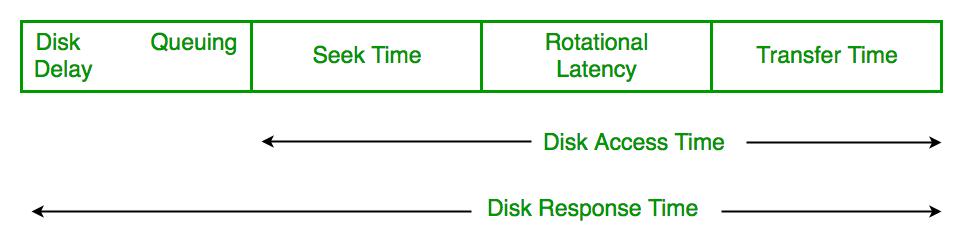
  • Seek Time: Seek time is the time taken to locate the disk arm to a specified track where the data is to be read or written. So the disk scheduling algorithm that gives a minimum average seek time is better.
  • Rotational Latency: Rotational Latency is the time taken by the desired sector of the disk to rotate into a position so that it can access the read/write heads. So the disk scheduling algorithm that gives minimum rotational latency is better.
  • Transfer Time: Transfer time is the time to transfer the data. It depends on the rotating speed of the disk and the number of bytes to be transferred.
  • Disk Access Time:
  • Disk Access Time = Seek Time + Rotational Latency + Transfer Time

Comments ()


Sign in

Read Next

(Input/Output) in os

Blog banner

Gamer life

Blog banner

Indian Culture and Tradition

Blog banner

Natural Language Processing(NLP)

Blog banner

Components of GIS

Blog banner

Buffer Overflow

Blog banner

"Mahakali cave"

Blog banner

Predictive Analysis - Ek Overview

Blog banner

How Reading Books Shape a Child’s Imagination and Thinking?

Blog banner

Data Visualization in Decision-Making

Blog banner

It's all about our Brain.- The Brain Metaphor

Blog banner

Survey of Which Movies Types people are Prefer to Watch in India.

Blog banner

File management

Blog banner

Sessions In OS.

Blog banner

5 Interesting facts about Diwali

Blog banner

A Journey By Train

Blog banner

A Heartfelt Act of Kindness

Blog banner

Introduction to Data Science: Life Cycle & Applications

Blog banner

Top 10 Logos and their meanings

Blog banner

How Puppet Shows and Role Play Teach Empathy to Preschoolers

Blog banner

Top 3 Places To Stay In Vienna

Blog banner

RAID

Blog banner

Security in Cloud Computing

Blog banner

VIDEO INTERVIEWS : A NEW ECOSYSTEM TO GET DREAM JOBS

Blog banner

VIRTUAL MACHINES

Blog banner

OPERATING SYSTEM

Blog banner

AutoML: The Future of Automated Data Science

Blog banner

Traditional Unix System

Blog banner

Jira service Management

Blog banner

Product Discount Calculator

Blog banner

Intrusion Detection System

Blog banner

Measuring IT Risk

Blog banner

File management

Blog banner

Virtualization

Blog banner

Understanding Endometriosis and Its Psychological Impact on Quality of Life

Blog banner

Rapido

Blog banner

Capacity management in ITSM

Blog banner

What is the point of living if we can die at any moment of our lives ?

Blog banner

Getting into Anime

Blog banner

Working with Sniffers for monitoring network communication

Blog banner

Data Mining

Blog banner

WomenEmpowerment

Blog banner