The international operation of a GSM system includes among others the interoperability with other GSM networks (including different countries) and with ISDN networks, as well as the information exchange among network operators (billing, statistical data, subscriber complaints, invalid IMEI etc.).This case study will highlight the emergence of GSM over the 1G: Analog Cellular Networks.
Introduction:-
Cellular communication means that there are a lot of different areas, looks like cell, contain communication system devices, such as antennas, base stations. If the base station antenna power is high, it means that it serves large areas.Otherwise, if the antenna power is low, it means that it serves little areas. However there are other parameters which affect the convergence. For example, to achieve a good communication in crowded areas, convergence should be reduced and the channel capacity should be increased.A lot of adjacent cells create the clusters.Clusters can have different amount of cells and each cell uses different frequency to avoid interference. These cluster structures repeat itself in different communication areas.
Mobile IP
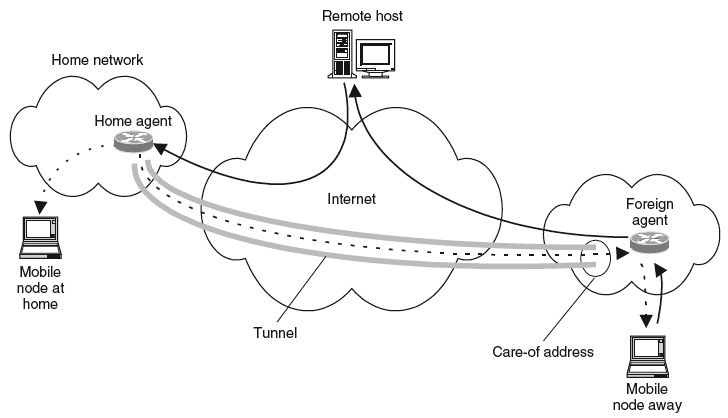
Shows a generic Mobile IP network. The mobile device attaches to a network through a router that terminates a radio interface1. Inside the network there are two mobility agents: a home agent and a foreign agent. Each mobile node has two addresses assigned to it. A home address that corresponds to its home network and a care-of address that corresponds to the network to which it is currently attached. When a mobile device attaches to a network, it receives a care-of address from the serving network.This is often the address of an interface on the foreign agent serving the mobile device. The mobile device then registers this address with its home agent. Mobile security associations are required between the mobile device and its home agent. In addition, further security associations may exist between the mobile device and the foreign agent, and the foreign and home agents.When packets are sent to the mobile device by a corresponding host, they are addressed to the home address of the mobile node. These packets are routed through the Internet as normal IP packets until they reach the home network of the mobile device.In the home network, the home agent of the mobile device intercepts these packets. The home agent encapsulates these packets inside packets that are addressed to the care-of address of the mobile device. These packets are then routed on the Internet as normal IP packets until they reach the foreign agent corresponding to the mobile device.In this way packets are tunneled through the network. The foreign agent decapsulates the original IP packets and forwards them to the mobile device. Packets sent from the mobile device may be treated as normal IP packets.When a mobile device moves between points of attachment on a network and changes foreign agent, it receives a new care-of address, and re-registers with its home agent. In this way, mobility management is performed. Mobile IP also defines mechanisms allowing mobile devices to perform their own decapsulation functions, by means of a co-located care-of address.In addition, the IETF is working on an extension to Mobile IP called route optimization [8], allowing the home agent to inform corresponding hosts about the current care-of address of mobile devices. Route optimization also allows packets to be forwarded from an old foreign agent to a new foreign agent, enabling smoother handoffs.
GSM:
GSM, the Global System for Mobile communications, is a digital cellular communications system that has rapidly gained acceptance and market share worldwide. In addition to digital transmission, GSM comprises many advanced services and features, including ISDN(Integrated Services Digital Network) compatibility and worldwide roaming in other GSM networks. GSM architecture is a combination of three subsystems: Base Station Subsystem (BSS), Network Switching Subsystem (NSS) & Operation Support Subsystem (OSS).BSS consists of Base Transceiver System (BTS) and Base System Controller (BSC) which connects with Mobile Station (MS). NSS consists of MSC which connects with BSC. OSS maintains BSS and NSS.GSM channels are responsible for connecting two MS’s. It consists of two channels: Traffic Channels (TCH) which makes data flow between two MS’s possible and Control Channels (CCH) which supervises the signaling and synchronization between the base station and mobile station. This paper will give an overview of GSM system architecture & its channels.Some of the basic criteria for their proposed system were:
Good subjective speech quality
Low terminal and service cost
Support for international roaming
Ability to support handheld terminals
Support for range of new services and facilities
Spectral efficiency
ISDN compatibility
Mobile IP may work in a GSM network. We consider four issues with mobility management: detecting a change in network attachment, micro mobility, paging, and roaming.
Conclusion:-
The communication development and the increase of living standard of people are directly related to the more use of cellular mobile. Cellular mobile radio-the high end sophisticated technology that enables everyone to communicate anywhere with anybody. The mobile telephony industry rapidly growing and that has become backbone for business success and efficiency and a part of modern lifestyles all over the world.In this case study we have tried to give and over view of the GSM system. We hope that we gave the general flavor of GSM and the philosophy behind its design. The GSM is standard that insures interoperability without stifling competition and innovation among the suppliers to the benefit of the public both in terms of cost and service quality.The features and benefits expected in the GSM systems are superior speech quality, low terminal, operational and service costs, a high level security, providing international roaming support of low power hand portable terminals and variety of new services and network facilities. In near forth coming days, the third generation mobile telephony becomes available whole over the world, which will give the facility of videoconference in mobile telephone.References:-
La Porta, T.F., Salgarelli, L. and Foster, G.T., 1999. Mobile IP and wide area wireless data. In Wireless Communications and Networking Conference, 1999. WCNC. 1999 IEEE(Vol. 3, pp. 1528-1532). IEEE.
Digital Cellular Telecommunication System, General Packet Radio Service (GSM 02.60, version 6.1), ETSI, 1997.
Digital Cellular Telecommunication System, Enhanced Data Rates for GSM Evolution - Project Plan and Open Issues for EDGE (GSM 10.59, version 1.6), ETSI, 1997.
E. Perkins, “IP Mobility Support,” IETF RFC 2002, October 1996.
Digital Cellular Telecommunication System, Network Architecture (GSM 3.02, version 6.1), ETSI, 1997.
800 MHz TDMA Cellular Radio Interface – Mobile Station – Base Station Compatibility, EIA/TIA IS-136, 1994
Mobile Station – Base Station Compatibility Standard for Dual-Mode Wide Band Spread Spectrum Cellular System, EIA/TIA IS-95, 1993.
IEEE Personal Communications Magazine Special Issue, “Third Generation Mobile Systems in Europe,” Davide Grillo Guest Editor, Vol. 5, No. 2, April, 1998.
E. Perkins, D. Johnson, “Route Optimizations for Mobile IP,” Internet Draft, November, 1997.
Calhoun and C. E. Perkins, DIAMETER Mobile IP Extensions, Internet Draft, November 1998.
Kent and R. Atkinson, Security Architecture for the Internet Protocol, IETF RFC 2401, November 1998.
K. Zao and M. Condell, Use of IPSec in Mobile IP, Internet Draft, November 1997.

 AUTHOR : Shashank Rajendraprasad Shukla
Aim:- To study how the mobile IP is used in GSM architecture.
AUTHOR : Shashank Rajendraprasad Shukla
Aim:- To study how the mobile IP is used in GSM architecture.