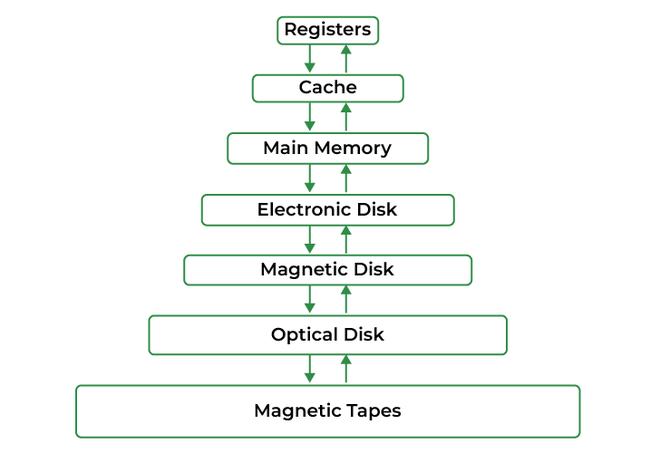
Memory management : in an operating system (OS) refers to the process of handling computer memory, including RAM and cache, to optimize system performance and resource utilization. It involves tracking every byte in a computer's memory, whether it is in use or free, and managing the allocation and deallocation of memory blocks to processes and applications. Memory management ensures that each process has enough memory to execute while also ensuring that the system doesn’t run out of memory, which can lead to crashes or performance issues. Key techniques include paging, segmentation, and virtual memory, which allow the system to simulate more memory than is physically available by using disk space. Efficient memory management is crucial for the smooth operation of a multitasking environment, as it ensures that all running processes have the necessary resources without interfering with each other.
Paging is a memory management scheme that eliminates the need for contiguous allocation of physical memory. The OS divides memory into fixed-sized blocks called pages. The logical address space is divided into pages, while the physical memory is divided into frames. When a program is executed, its pages are loaded into available frames. Paging helps in efficient memory utilization and eliminates fragmentation issues. The page table is a crucial data structure that maintains the mapping between logical addresses and physical memory.
Segmentation is a memory management technique where the memory is divided into segments of different sizes, each representing a logical unit such as a function, array, or object. Unlike paging, which divides memory into fixed-sized blocks, segmentation divides memory based on the program’s logical structure. Each segment is assigned a segment number and offset. The main advantage of segmentation is that it allows for easier implementation of modular programs and better protection, as each segment can be independently protected.
Virtual memory is a technique that allows the execution of processes that may not be completely loaded into physical memory. By using disk space as an extension of RAM, virtual memory enables larger programs to run on systems with limited physical memory. It works by swapping pages of data between RAM and disk storage as needed. This technique provides the illusion of a large, contiguous memory space to processes, allowing them to run efficiently even with limited physical memory. Virtual memory is crucial for multitasking systems where multiple processes need to run simultaneously.
Fragmentation refers to the inefficient use of memory, leading to wasted space. It occurs in two forms: internal and external fragmentation. Internal fragmentation happens when allocated memory blocks have unused space within them, while external fragmentation occurs when free memory is scattered in small blocks across the system. Fragmentation can lead to a shortage of usable memory, even if enough total memory is available. Techniques like paging and defragmentation help minimize the impact of fragmentation.