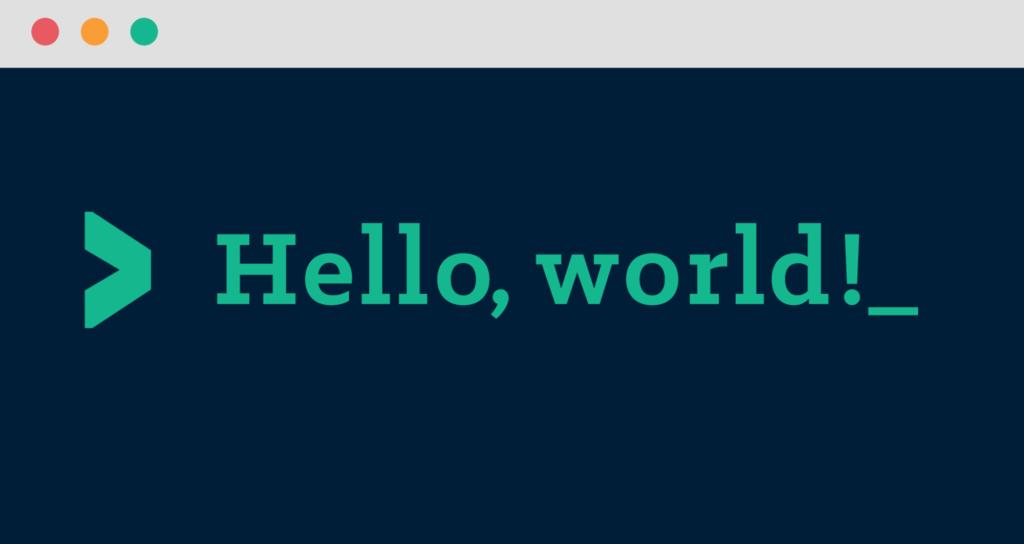
A "Hello, World!" program is generally a computer program that ignores any input and outputs or displays a message similar to "Hello, World!". A small piece of code in most general-purpose programming languages, this program is used to illustrate a language's basic syntax. "Hello, World!" programs are often the first a student learns to write in a given language,[1] and they can also be used as a sanity check to ensure computer software intended to compile or run source code is correctly installed, and that its operator understands how to use it.
While small test programs have existed since the development of programmable computers, the tradition of using the phrase "Hello, World!" as a test message was influenced by an example program in the 1978 book The C Programming Language,[2] but there is no evidence that it originated there, and it is very likely it was used in BCPL beforehand (as below). The example program in that book prints "hello, world", and was inherited from a 1974 Bell Laboratories internal memorandum by Brian Kernighan, Programming in C: A Tutorial:[3]
main( ) {
        printf("hello, world");
}
In the above example, the main( ) function defines where the program should start executing. The function body consists of a single statement, a call to the printf function, which stands for "print formatted". This function will cause the program to output whatever is passed to it as the parameter, in this case the string hello, world.
The C language version was preceded by Kernighan's own 1972 A Tutorial Introduction to the Language B,[4] where the first known version of the program is found in an example used to illustrate external variables:
main( ) {
    extern a, b, c;
    putchar(a); putchar(b); putchar(c); putchar('!*n');
}

a 'hell';
b 'o, w';
c 'orld';
The program prints hello, world! on the terminal, including a newline character. The phrase is divided into multiple variables because in B a character constant is limited to four ASCII characters. The previous example in the tutorial printed hi! on the terminal, and the phrase hello, world! was introduced as a slightly longer greeting that required several character constants for its expression.
The Jargon File claims that "hello, world" originated instead with BCPL (1967).[5] This claim is supposedly supported[according to whom?] by the archived notes of the inventors of CPL, Christopher Strachey and BCPL, Martin Richards at Cambridge. The phrase predated by over a decade its usage in computing; as early as the 1950s, it was the catchphrase of New York radio disc jockey William B. Williams.[6]