wisemonkeys logo
FeedNotificationProfileManage Forms
FeedNotificationSearchSign in
wisemonkeys logo

Blogs

Starvation

profile
E 070 MEET HIRANI
Aug 14, 2024
0 Likes
0 Discussions
94 Reads

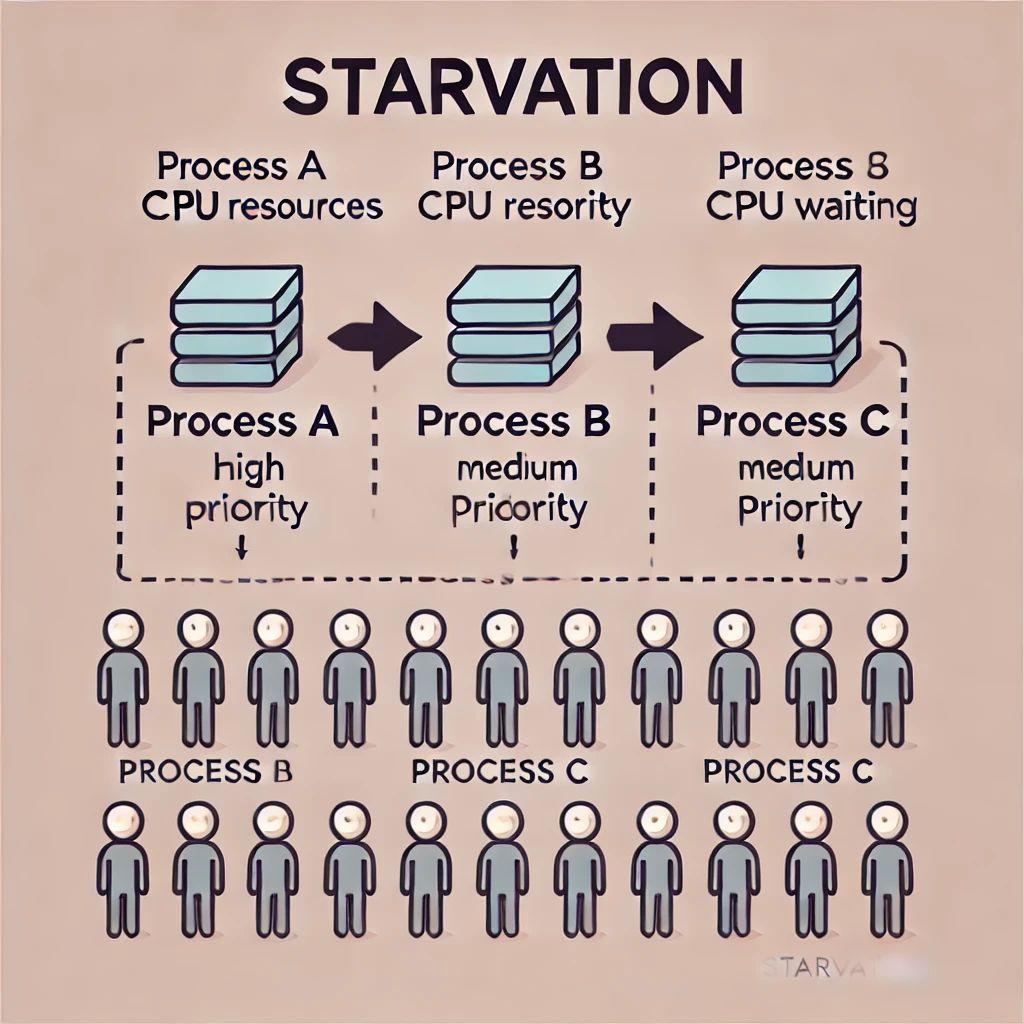
Starvation in an operating system occurs when a process is continuously overlooked by the scheduler and never gets the resources it needs to execute, even though it is ready to run. This happens because other processes with higher priority or greater resource needs keep getting those resources instead.


Example:

Imagine you're at a cafeteria where everyone is supposed to take turns to get food. However, every time you're about to get your turn, someone more important or more demanding cuts in line. As a result, you keep waiting and never get your meal. This situation is called starvation.


Key Points:

Resource Allocation: Starvation occurs when a process is ready to execute but never gets the CPU, memory, or other resources it needs.

Priority Issues: Often happens in systems where higher-priority tasks keep getting resources, causing lower-priority tasks to be ignored.

Continuous Waiting: The process remains in the queue indefinitely, never getting the chance to run.

In Operating Systems:

Starvation can happen in scheduling algorithms that favor certain processes over others. For example, in a priority-based scheduling system, a low-priority process might never get CPU time if higher-priority processes keep arriving.


Example in Operating Systems:

Suppose you have three processes in a system:


High-priority Process A: Requires a lot of CPU time.

Medium-priority Process B: Also needs CPU but not as much as A.

Low-priority Process C: Requires minimal CPU time.

If Process A and Process B keep getting CPU time because they have higher priorities, Process C might never get a chance to run, even though it is ready. This is starvation for Process C.


Summary:

Starvation in an operating system is when a process is ready to run but is continually denied the resources it needs, often because other processes are given priority. It’s like waiting in a line where others keep cutting ahead, leaving you without your turn.



Comments ()


Sign in

Read Next

Types Of Interrupt

Blog banner

BUSINESS MODELS OF E COMMERCE

Blog banner

Travelling blog

Blog banner

Deadlock

Blog banner

Is Your Password Complex Enough?

Blog banner

What is Internet

Blog banner

5 Powerful Mindset Shifts To Make 2026 Your Breakthrough Year

Blog banner

Human factor, a critical weak point in the information security of an organization’s IOT

Blog banner

ACHIEVEMENTS IN OPERATING SYSTEMS

Blog banner

Guidelines for a low sodium diet.

Blog banner

Subnet Masking

Blog banner

The Bold Digital Marketing Moves That Made Durex India’s Second-Largest Condom Brand

Blog banner

What is Password Cracking ? and it's Techniques.

Blog banner

Direct Memory Access

Blog banner

Service Operations Principles

Blog banner

Be you

Blog banner

CYBERPEACEKEEPING: NEW WAYS TO PREVENT AND MANAGE CYBERATTACKS

Blog banner

Memory Management

Blog banner

Big Data Architecture

Blog banner

Rain

Blog banner

Deadlock and Starvation

Blog banner

Segmentation and paging concept

Blog banner

Therapy Myths That Need to End in 2025

Blog banner

Binary Search Tree (BST) in Data Structure

Blog banner

Technological Advancement

Blog banner

What is Data, Information and Knowledge?

Blog banner

How can parents support a child’s mental health?

Blog banner

DMZ: Your Secret Weapon for Data Security

Blog banner

SQL Injection

Blog banner

Sniffing: A Cyber Security Threat

Blog banner

Open Source Project By Google

Blog banner

Review on Recovering Deleted Files

Blog banner

MAILFENCE

Blog banner

Risk mitigation and management

Blog banner

Banaras

Blog banner

The Role of Cyber Forensics in Addressing Cyber security Challenges in Smart Cities

Blog banner

The Psychology of Diversity, Equity & Inclusion: How Inclusive Workplaces Boost Productivity

Blog banner

MPL and how its effects?

Blog banner

Memory management

Blog banner

SECURITY RISKS OF REMOTE WORKING

Blog banner

OS ASSIGNMENT

Blog banner

Uniprocessor Scheduling

Blog banner