wisemonkeys logo
FeedNotificationProfileManage Forms
FeedNotificationSearchSign in
wisemonkeys logo

Blogs

geographic information system (GIS)

profile
Ameya Gawade
Mar 16, 2023
0 Likes
0 Discussions
213 Reads

A geographic information system (GIS) consists of integrated computer hardware and software that store, manage, analyze, edit, output, and visualize geographic data.[1][2] Much of this often happens within a spatial database, however, this is not essential to meet the definition of a GIS.[1] In a broader sense, one may consider such a system also to include human users and support staff, procedures and workflows, the body of knowledge of relevant concepts and methods, and institutional organizations.

The uncounted plural, geographic information systems, also abbreviated GIS, is the most common term for the industry and profession concerned with these systems. It is roughly synonymous with geoinformatics and part of the broader geospatial field, which also includes GPS, remote sensing, etc. Geographic information science, the academic discipline that studies these systems and their underlying geographic principles, may also be abbreviated as GIS, but the unambiguous GIScience is more common.[3] GIScience is often considered a subdiscipline of geography within the branch of technical geography.

History and development

While digital GIS dates to the mid-1960s, when Roger Tomlinson first coined the phrase "geographic information system",[5] many of the geographic concepts and methods that GIS automates date back decades earlier.

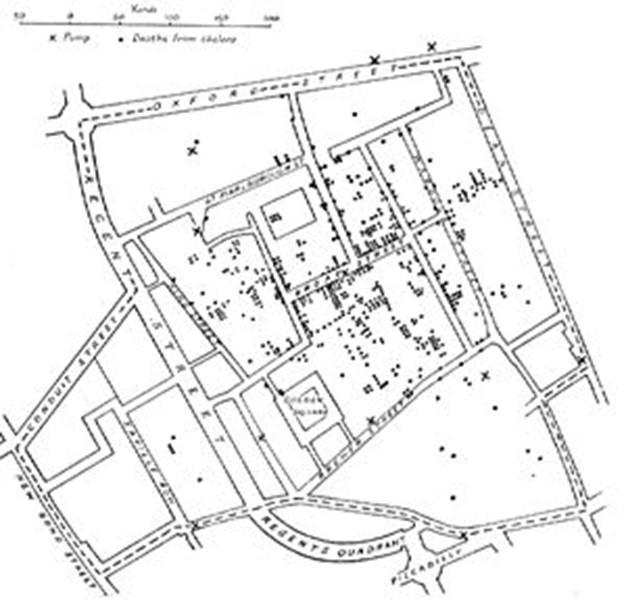
One of the first known instances in which spatial analysis was used came from the field of epidemiology in the "Rapport sur la marche et les effets du choléra dans Paris et le département de la Seine" (1832).[6] French geographer and cartographer, Charles Picquet created a map outlining the forty-eight Districts in Paris, using halftone color gradients, to provide a visual representation for the number of reported deaths due to cholera per every 1,000 inhabitants.


Comments ()


Sign in

Read Next

FILE SHARING

Blog banner

Challenges of Digital forensics in cloud computing environment

Blog banner

File management in os

Blog banner

Deadlock in operating system

Blog banner

10 Interesting facts you should know!!!

Blog banner

Session Hijacking

Blog banner

Cycling

Blog banner

How to tie a Tie

Blog banner

memory cache

Blog banner

Water Resources are about to exhaust...

Blog banner

1.1 basic elements

Blog banner

CONCURRENCY: MUTUAL EXCLUSION AND SYNCHRONIZATION-het karia

Blog banner

Partnership in Learning: How Parent Involvement Shapes a Child’s Early Education

Blog banner

Why is it hard to design an Operating Systems ?

Blog banner

OPERATING SYSTEM

Blog banner

Data Lake

Blog banner

Raid and levels of raid.

Blog banner

Short note on Microsoft office

Blog banner

The Memory Hierarchy

Blog banner

Docker Framework

Blog banner

Instagram Features in 2023 That Will Leave You Stunned!

Blog banner

How China Regained It's World's Largest Growing Economy Status

Blog banner

Memory Management in an Operating System

Blog banner

Race Conditions

Blog banner

Getting started with Android Studio

Blog banner

5 Interesting facts about Diwali

Blog banner

Photorec - media recovery tool

Blog banner

Process Creation

Blog banner

Memory management

Blog banner

India Digital Personal Data Protection Act, 2023

Blog banner

undefined

Blog banner

OS assignment 3

Blog banner

Question

Blog banner

PHONE TECHNOLOGY

Blog banner

WINDOWS I/ O

Blog banner

MAHAKAL LOK UJJAIN

Blog banner

GIS in Disaster Management

Blog banner

AI and Data Science: Revolutionizing Industries

Blog banner

Dancing Classes In Mumbai

Blog banner

A Happier Workplace Starts with Healthy Lunches by Meal Maharaj

Blog banner

MY MOST THRILLED TREK ..... BHAIRAVGAD

Blog banner

Multiprocessor and Multicore Organization

Blog banner