Big-O Analysis of Algorithms
We can express algorithmic complexity using the big-O notation. For a problem of size N:
Definition: Let g and f be functions from the set of natural numbers to itself. The function f is said to be O(g) (read big-oh of g), if there is a constant c > 0 and a natural number n0 such that f(n) ≤ cg(n) for all n ≥ n0 .
Note: O(g) is a set!
Runtime Analysis of Algorithms
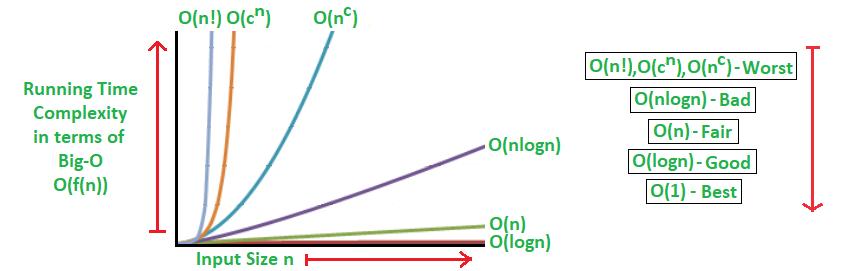
In general cases, we mainly used to measure and compare the worst-case theoretical running time complexities of algorithms for the performance analysis.
The fastest possible running time for any algorithm is O(1), commonly referred to as Constant Running Time. In this case, the algorithm always takes the same amount of time to execute, regardless of the input size. This is the ideal runtime for an algorithm, but it’s rarely achievable.
In actual cases, the performance (Runtime) of an algorithm depends on n, that is the size of the input or the number of operations is required for each input item.