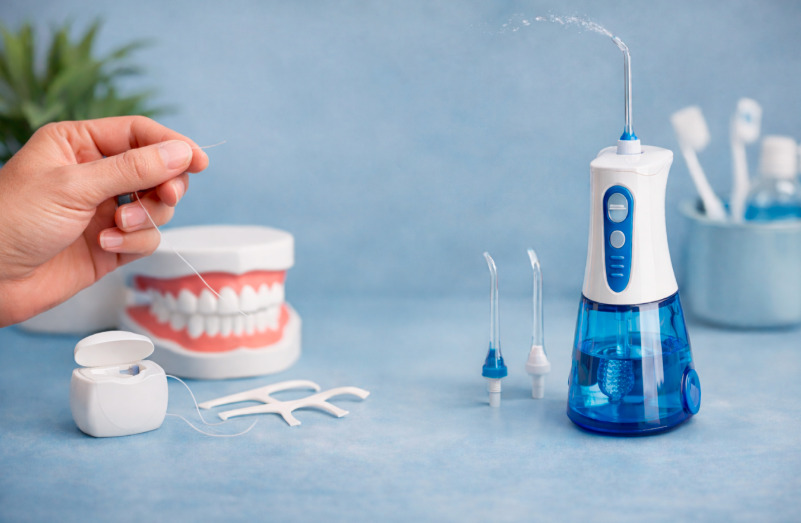
Good oral hygiene goes beyond brushing your teeth twice a day. One of the most important steps in keeping your teeth and gums healthy is cleaning between your teeth. This is where plaque and food particles tend to collect, and unfortunately, these areas are the hardest to reach with a toothbrush alone.
In recent years, water flossers have become a popular alternative to traditional string floss. Many patients prefer them because they are easier to use, gentler on the gums, and feel more comfortable during daily cleaning. This often leads to the question dentists hear regularly during check-ups:
The short answer is no. While water flossers are helpful, they work best when used alongside traditional floss, not as a replacement.
A water flosser, also known as an oral irrigator, is a device that uses a pressurised stream of water to clean around the teeth and along the gum line. The water jet helps wash away loose food debris and bacteria that brushing may leave behind.
Research has shown that water flossers can improve gum health and reduce bleeding. Some studies, including findings published in dental research journals, suggest that many patients actually prefer water flossers because they are gentler and avoid the gum bleeding that some people experience when using traditional floss.
For patients who find string floss uncomfortable or difficult to use, a water flosser can be a very helpful addition to their daily routine.
But it is important to understand what water flossers can and cannot do.
The key difference lies in how plaque is removed.
Plaque is a sticky biofilm that clings tightly to the surfaces of teeth. Water can rinse away food debris, but it cannot always remove the thin layer of plaque that sticks to the sides of teeth and under the gumline.
Traditional string floss physically scrapes this plaque away. When floss slides between teeth and curves around each tooth surface, it removes plaque before it has the chance to harden into tartar.
Once plaque turns into tartar, it can only be removed by a dentist or dental hygienist.
Let’s understand this well with an analogy: Imagine you spilled sauce on a plate. Running water over the plate may wash away some of the residue, but a thin film will often remain stuck to the surface. To remove it completely, you need a sponge or a cloth to wipe it away.
Your teeth work similarly. A water flosser is like rinsing the plate, while manual string floss acts like the sponge that scrubs the surface clean.
Both are useful, but they serve different purposes.
Water flossers can be extremely beneficial for certain patients, particularly those who have:
The water stream can help flush out bacteria and food particles from areas that are difficult to access with traditional floss alone.
For these patients, water flossers can significantly improve their oral hygiene routine.
| Parameter | Manual String Floss | Water Flosser |
| Cleaning Mechanism | Physically scrapes plaque off tooth surfaces | Uses a pressurised stream of water to rinse debris |
| Plaque Removal | Very effective at removing sticky plaque from tooth surfaces | Helps reduce bacteria, but does not scrape plaque effectively |
| Food Particle Removal | Excellent for removing stuck food between tight teeth | Good for flushing out loose food particles |
| Effect on Gums | Can cause bleeding if the gums are inflamed or the technique is poor | Gentle on gums and often preferred by sensitive patients |
| Ease of Use | Requires manual skill and proper flossing technique | Easier for many people to use daily |
| Best For | Tight spaces between teeth and plaque removal | Gum stimulation and rinsing bacteria |
| Patients with Braces / Implants | Can be difficult around orthodontic wires | Very useful for cleaning around braces, bridges and implants |
| Cost & Portability | Inexpensive and easy to carry | Higher initial cost and requires charging or batteries |
The most effective dental care routine often involves combining tools rather than choosing one over the other. String floss removes plaque by scraping along the tooth surface, while water flossers help flush away debris and bacteria from hard-to-reach areas.
When used together, they complement each other and provide a more complete level of cleaning between the teeth. Healthy gums and strong teeth depend on consistent daily habits. Brushing, flossing, and regular dental check-ups all work together to prevent cavities, gum disease, and long-term oral health problems.
Water flossers can make cleaning easier and more comfortable for many people, but they should be seen as an addition to flossing, not a replacement for it.
At Gentle and Caring Dentistry, we help patients build simple, effective oral hygiene routines that protect their smiles for years to come. If you would like personalised advice on flossing techniques or improving your daily dental care, our team is always here to guide you.
Because when it comes to oral health, the small habits you practise every day make the biggest difference.