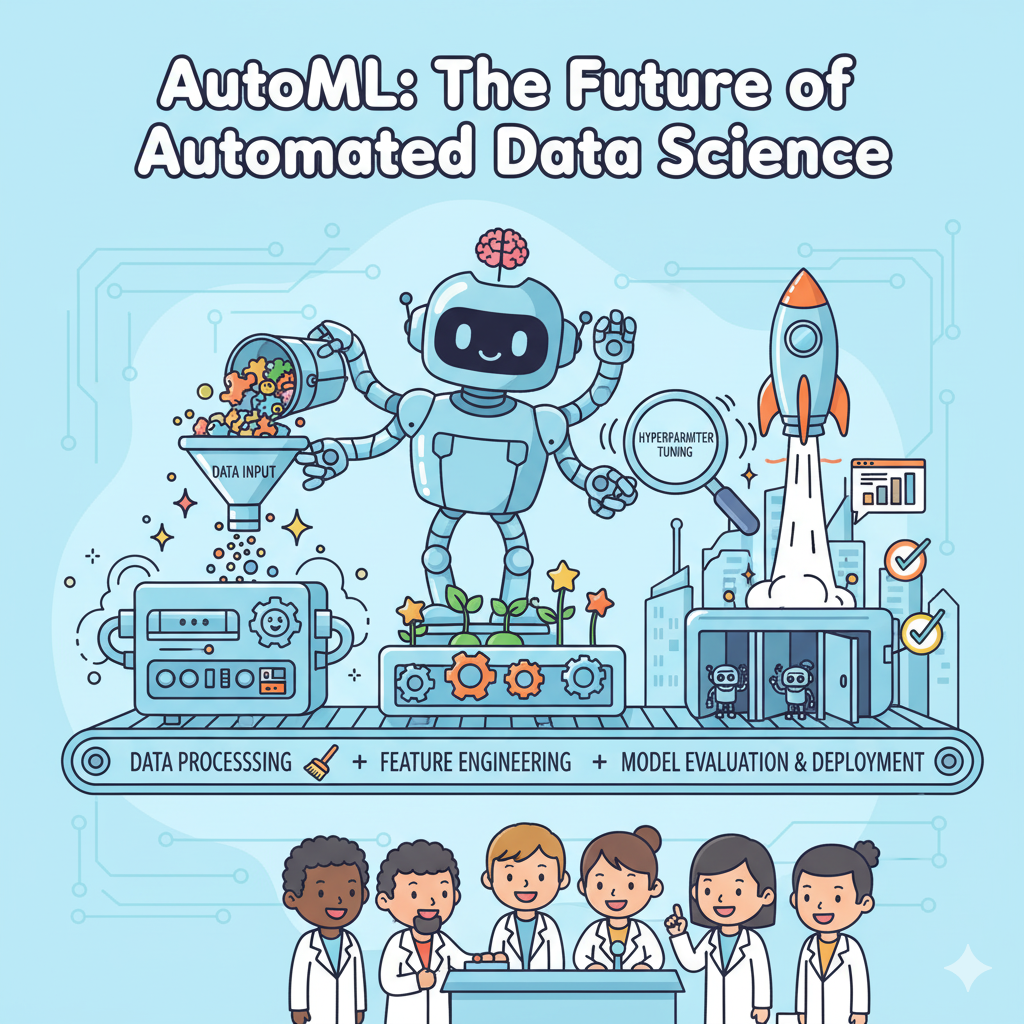
AutoML is a technology designed to automate the creation of machine learning models. Traditionally, building a model involves multiple steps like cleaning data, selecting features, choosing the right algorithm, tuning parameters, training, and testing. AutoML handles all of these steps automatically, making it possible for even non-experts to create accurate models quickly.
Think of AutoML as a “machine that builds smart machines.” You feed it data, and it returns a ready-to-use AI model.

Step 1: Data Input – You provide the dataset in CSV, Excel, or database format.
Step 2:Data Preprocessing – AutoML cleans your data, fills missing values, and transforms it for analysis.
Step 3:Feature Engineering – It identifies or creates the most important features that improve model performance.
Step 4:Model Selection – AutoML tests multiple machine learning algorithms automatically.
Step 5:Hyperparameter Tuning – It finds the best settings for each model to boost accuracy.
Step 6:Model Evaluation – The system evaluates the models on unseen data and selects the best one.
Step 7:Deployment – The final model is ready for real-world predictions.
Business: Predicting customer churn and sales forecasts.
Healthcare: Diagnosing diseases using medical data.
Finance: Detecting fraud and scoring credit risk.
Retail: Building recommendation systems for customers.
Saves Time and Effort – Automates repetitive tasks.
Reduces Dependency on Experts – You don’t need a team of data scientists to build models.
Quick Testing of Multiple Models – Finds the best-performing model faster.
Accessible to Everyone – Makes machine learning approachable for non-technical users.
Cost – Large datasets can make AutoML expensive.
Flexibility – Custom models by experts may outperform AutoML in specific cases.
Business Nuances – AutoML may not fully understand domain-specific details.
User-Friendly Tools – Easier interfaces for non-technical users.
Cloud Integration – Faster model building and deployment using cloud computing.
Industry Adoption – Wider use in healthcare, finance, and education.
Continuous Learning Pipelines – Automated systems that improve models over time.
AutoML is the future of data science, making machine learning faster, simpler, and more accessible. It empowers businesses, healthcare providers, financial institutions, and many others to leverage AI without needing deep technical expertise. As technology evolves, AutoML will continue to play a key role in automating AI, making it smarter and more efficient every day.