wisemonkeys logo
FeedNotificationProfileManage Forms
FeedNotificationSearchSign in
wisemonkeys logo

Blogs

Message Passing in OS

profile
Vaibhav Chauhan
Sep 09, 2024
0 Likes
0 Discussions
62 Reads

Message Passing


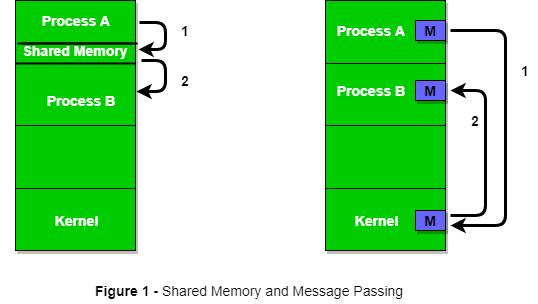
 When processes interact with one another, two fundamental requirements must be satisfied: synchronization and communication. Processes need to be synchronized to enforce mutual exclusion; cooperating processes may need to exchange information. One approach to providing both of these functions is message passing. Message passing has the further advantage that it lends itself to implementation in distributed systems as well as in shared-memory multiprocessor and uniprocessor systems.


Message-passing systems come in many forms. In this section, we provide a general introduction that discusses features typically found in such systems. The actual function of message passing is normally provided in the form of a pair of primitives:


send (destination, message)

` receive (source, message)


This is the minimum set of operations needed for processes to engage in message passing. A process sends information in the form of a message to another process designated by a destination . A process receives information by executing the receive primitive, indicating the source and the message . 


Synchronisation:


 The communication of a message between two processes implies some level of synchronization between the two: The receiver cannot receive a message until it has been sent by another process. In addition, we need to specify what happens to a process after it issues a send or receive primitive.


Consider the send primitive first. When a send primitive is executed in a process, there are two possibilities: Either the sending process is blocked until the message is received, or it is not. Similarly, when a process issues a receive primitive, there are two possibilities:


1. If a message has previously been sent, the message is received and execution continues.

2. If there is no waiting message, then either

(a) the process is blocked until a message arrives, or

(b) the process continues to execute, abandoning the attempt to receive. 


Comments ()


Sign in

Read Next

How To Invest in Indian Stock Market For Beginners. ~ Tutorial 2 (NSDL And CSDL) Continued...

Blog banner

Virtual memory

Blog banner

Cyber Security Control

Blog banner

The Features of Blockchain

Blog banner

Culture Of Ladakh

Blog banner

EdTech (Education Technology)

Blog banner

Memory heirchy

Blog banner

10 Reasons why Monica and Chandler are the best couple ever.!!!

Blog banner

Memory Management

Blog banner

Why is it hard to design an Operating Systems ?

Blog banner

E-Cash (Electronic Cash)

Blog banner

computer security

Blog banner

GIS Bharat Maps

Blog banner

DMZ: Your Secret Weapon for Data Security

Blog banner

ADIDAS

Blog banner

Privacy LAWs in IT

Blog banner

The Impact of Tolerances and Wall Thickness on Pipeline Integrity

Blog banner

Having passion in life

Blog banner

Blockchain Transactions

Blog banner

Major achievement

Blog banner

Friendship

Blog banner

Memory input output management

Blog banner

EMAIL INVESTIGATION

Blog banner

Types of Big Data

Blog banner

Digital Marketing Ethics Transparency Trust And Brand Reputation digital

Blog banner

File management in os

Blog banner

Why Festivals Are the Best Classrooms for Young Minds?

Blog banner

Random Forests

Blog banner

The Art Of Getting What You Want In Life....

Blog banner

Importance of modern technology era

Blog banner

Platonic Solids

Blog banner

The War With Cold On Earth

Blog banner

Deadlock and Starvation

Blog banner

Stop Racism

Blog banner

Guidelines for a Low sodium Diet.

Blog banner

An Overview of Virtual Machines

Blog banner

Direct memory access (DMA)

Blog banner

The Joy of Giving: How Festivals Teach Children Empathy and Gratitude

Blog banner

What Makes Patola the Queen of Silk?

Blog banner

Answer

Blog banner

Real time scheduling

Blog banner

Deadlock and starvation in operating system

Blog banner