Real-Time Operating Systems (RTOS)
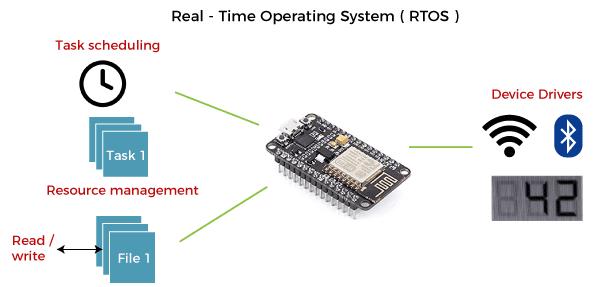
A Real-Time Operating System (RTOS) is a specialized operating system designed to manage hardware resources, run applications, and process data with very high predictability and reliability, especially for tasks that must meet specific timing constraints. These constraints can be categorized into "hard" and "soft" real-time requirements.
Characteristics of RTOS
1. Determinism
Predictable Timing: The key characteristic of an RTOS is determinism, which means the operating system guarantees that a task will execute within a known time frame. The system must handle interrupts and process scheduling within strict time limits, ensuring tasks meet their deadlines.
2. Hard and Soft Real-Time Systems
Hard Real-Time Systems:
Strict Deadlines: In a hard real-time system, missing a deadline could result in catastrophic consequences. These systems are found in critical applications like medical devices (e.g., pacemakers), automotive airbag systems, or avionics control systems.
Zero Tolerance for Delays: In these systems, the timing constraints are non-negotiable. For example, an airbag must deploy within milliseconds of detecting a collision; failure to meet this deadline could lead to loss of life.
Soft Real-Time Systems:
Flexible Deadlines: In a soft real-time system, missing a deadline might degrade performance but is not catastrophic. These systems are used in less critical applications where timing is important but not life-threatening.
Tolerant to Delays: An example is multimedia streaming, where occasional frame drops are acceptable but should be minimized to maintain user experience.
3. Real-Time Scheduling Algorithms
Priority-Based Scheduling:
Fixed Priority Scheduling: Tasks are assigned a priority level, and the RTOS schedules tasks based on these priorities. Higher-priority tasks preempt lower-priority ones.
Rate Monotonic Scheduling (RMS): A static priority algorithm where tasks with shorter periods are assigned higher priorities. RMS is optimal for fixed-priority scheduling but only works well if tasks are independent and periodic.
Dynamic Priority Scheduling:
Earliest Deadline First (EDF): A dynamic scheduling algorithm where the task closest to its deadline is given the highest priority. EDF is theoretically optimal for uniprocessor systems but can be more complex to implement than fixed-priority systems.
Round Robin Scheduling:
Time-Slice Allocation: Tasks are executed in a cyclic order, with each task getting a fixed time slice. This method is simple and fair but not necessarily optimal for real-time tasks where deadlines vary.
4. RTOS Design Issues
Interrupt Handling:
Fast and Predictable: RTOS must handle interrupts quickly and predictably to ensure minimal latency in responding to external events. Interrupt latency (time from interrupt generation to start of the ISR) and jitter (variation in response time) are critical metrics.
Memory Management:
No Paging or Swapping: RTOS often avoids paging and swapping because these operations introduce unpredictable delays. Instead, they use fixed-size memory partitions or memory pools.
Task Synchronization and Communication:
Mutexes and Semaphores: RTOS uses synchronization primitives like mutexes and semaphores to ensure data consistency when multiple tasks access shared resources.
Priority Inversion Management: RTOS must handle priority inversion, where a lower-priority task holds a resource needed by a higher-priority task, possibly through priority inheritance mechanisms.
Scalability and Modularity:
Minimal Footprint: RTOS is designed to be highly modular and scalable, with a minimal footprint, making them suitable for embedded systems with limited resources.
Error Handling and Recovery:
Fault Tolerance: RTOS must incorporate mechanisms for error detection, handling, and recovery to ensure system stability, especially in mission-critical applications.
Applications of RTOS
1. Embedded Systems
Definition: Embedded systems are dedicated computer systems designed for specific control functions within larger systems. They often operate in real-time environments where precise timing is critical.
Examples:
Automotive Systems: RTOS is used in engine control units (ECUs), anti-lock braking systems (ABS), and infotainment systems.
Medical Devices: Devices like infusion pumps, patient monitoring systems, and pacemakers rely on RTOS for reliable and timely operation.
2. Robotics
Definition: Robotics involves the design, construction, and operation of robots, which often require real-time control for precise movements and interactions with their environment.
Examples:
Industrial Robots: RTOS is used to control robotic arms on assembly lines, ensuring precise timing for tasks like welding, painting, or assembling components.
Autonomous Vehicles: RTOS manages the real-time processing of sensor data and control algorithms for self-driving cars, drones, or underwater robots.
3. Industrial Automation
Definition: Industrial automation refers to the use of control systems, such as computers or robots, for handling different processes and machinery in an industry to replace human intervention.
Examples:
Programmable Logic Controllers (PLCs): RTOS is used in PLCs, which are critical for controlling machinery, processing plants, and power systems, where real-time response is necessary for safety and efficiency.
SCADA Systems: Supervisory Control and Data Acquisition (SCADA) systems use RTOS to monitor and control industrial processes in real-time, such as power grids, water treatment plants, and oil and gas pipelines.