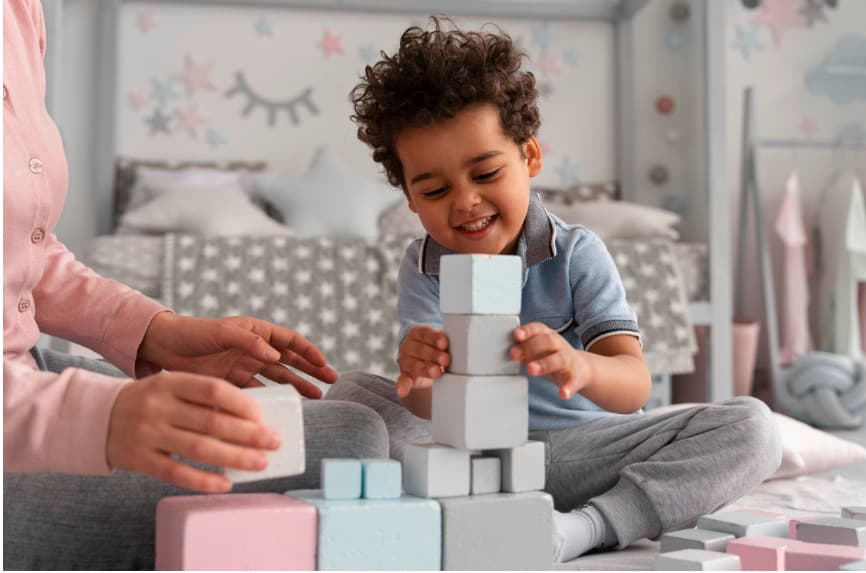
Give a preschool child some blocks, magnetic tiles, cardboard, or construction material, and he or she might just surprise you with how fast they can be transformed into towers, buildings, bridges, roads, or something entirely new. Construction activities appear to be a form of play but actually provide a chance for children to experiment, problem-solve, make decisions, and communicate their thoughts.
Construction provides an opportunity for learning through play and the exploration of key concepts of size, shape, balance, space, and motion. Children get to learn from experience as they construct, deconstruct, and reconstruct their creations in various ways. Studies have shown connections between block building and children’s spatial ability, whereas others have focused on the connection between block building and math, as well as self-regulation.
1. Building Activities Encourage Problem-Solving Skills
A tower can continue to fall. A bridge might not be able to support a toy car. The two parts may not fit properly. Rather than stopping immediately, kids start thinking about what they need to change.
Kids can make the base bigger, choose another block, take away some of the heavy pieces, or try an entirely new solution. In this way, kids are encouraged to look at the problem, think of different ways to solve it, try them out, and change something.
Such basic experiences can teach kids how to approach problem-solving in different situations.
2. It Develops Spatial Awareness
Spatial awareness is the knowledge of knowing how things relate in terms of positioning and location. Activities related to building provide numerous chances for developing this kind of knowledge.
When kids are trying to figure out where a particular block should be placed, either above, below, next to, inside, behind or in front of another thing, they are gaining practical understanding about space.
Children learn how to perceive different aspects such as size, distance, position, direction, and other important elements. There are numerous studies conducted on preschool block-building play that prove links between block-building and spatial knowledge.
All of these experiences will lead to a better understanding of shapes, structures, and patterns.
3. Construction Play Supports Early Mathematical Thinking
The child does not need a worksheet to get started on math. Construction play provides several ways to teach math skills naturally.
While building the tower, the child could count the number of blocks they are using. They might compare the height of towers, determine which block is bigger, and recognise that two smaller blocks can be placed together to occupy the same space as one big block.
Other mathematical concepts the child can learn during construction play include:
Thus, construction toys offer many opportunities to learn math.
4. It Strengthens Fine-Motor Skills
Grabbing a small block may appear effortless, yet children require dexterity and coordination to place it in its rightful place.
In the process of connecting components, stacking blocks, balancing objects, and positioning smaller things, they exercise the use of their fingers, hands, and wrists more efficiently.
Greater control of small movements will allow children to do such actions as drawing, colouring, cutting, manipulating classroom objects, and finally, writing. Thus, construction play provides children with a chance to exercise without feeling that they are doing physical exercises.
5. Building Encourages Creativity and Imagination
One does not always have to take a single approach when constructing anything.
A kid might construct a castle using his building blocks one day and construct a zoo or a town from those very same blocks the following day. This gives children room to test out their own thoughts and theories.
Through open-ended construction, kids are made to pose themselves such questions as:
In other words, open-ended construction enables kids to give concrete shape to their imaginations.
6. It Teaches Children About Cause and Effect
The act of construction is loaded with mini-experiments.
Very soon, children find out that placing a large weight above a fragile tower might make it collapse. A base that is too thin might result in the tower collapsing. If pieces are put together differently, the structure becomes stronger.
Thus, some fundamental concepts of cause and effect are discovered informally.
Children discover how things happen because of certain actions. In case something doesn’t work, children have an opportunity to reconsider and start afresh. Therefore, construction games are a wonderful medium for exploring the world for young children.
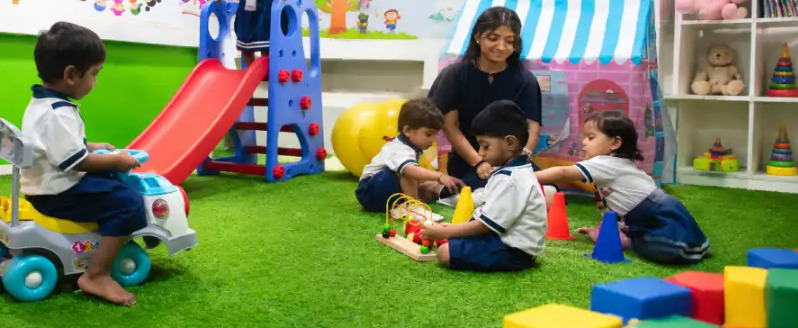
Building and construction activities provide a tremendous chance for preschoolers to learn by doing something tangible. From finding solutions to small problems to exploring space, building and construction activities help improve fine motor skills, creativity, cooperation with peers, and more. In Elzee Preschool & Daycare, kids have the chance to participate in an environment that is favourable for learning and where play and exploration are part of early education. Parents can check How Puzzles Help Young Children Develop Logical Thinking to find out another effective way of enhancing problem-solving and thinking skills. After all, the true power of constructing play does not lie in how cool the structure is in the end, but rather in the process of selecting the elements, construction itself, experimentation with them, and making changes.