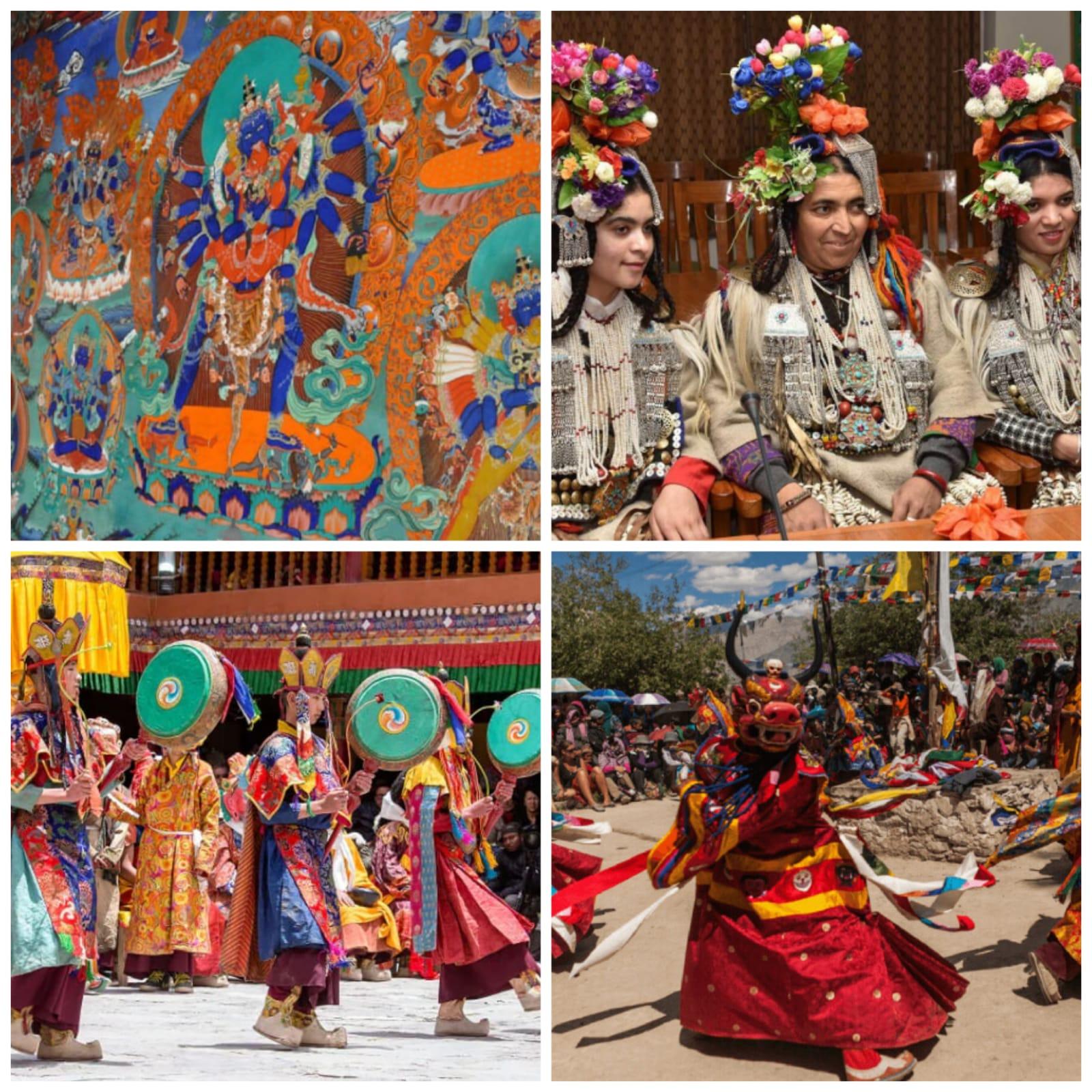
ABOUT ART & CULTURE OF LADAKH
The first observation that a tourist has upon visiting Ladakh for the first time is the strong influence of Tibetan culture. The words “mini Tibet” will immediately be uttered by those that have been to Tibet at some point or the other.
From the costumes worn by the people to their cuisine, almost everything is heavily influenced by Tibetan culture & Buddhism. However, despite this, the culture of Ladakh is rich and fascinating.
The demography of Ladakh too, has played a strong role in shaping its culture as it exists today. Much of the everyday life of the Ladakhi people revolves around the gompa or monasteries, which is a major part of their culture.
The people of Ladakh also celebrate several festivals throughout the year, some of the most famous ones being Losar, Hemis Tsechu & Saka Dawa. A lot of their time is also spent in making stone jewellery, woollen clothes, and mural paintings on the walls of the monasteries, which is done by both laymen and monks and symbolises the various aspects of Buddhism.
AN INSIGHT INTO Art & CULTURE & LIFE STYLE OF LADAKHI PEOPLE
We can get an idea about the culture of Ladakh by looking at its language, costume, cuisine, music & dance & tradition.
Language : The languages spoken in Ladakh are:
LadakhiTibetanUrduBalti
However, Ladakhi & Tibetan are used by the locals in their everyday life.
Costume : The men in Ladakh wear a long woollen robe which is known as Goucha in their local language. Women wear a similar kind of robe which is called Kuntop & Bok. Perak, a long hat, is also worn by both men & women in Ladakh.
Cuisine : Most of the dishes in Ladakh are prepared from the local produce which consists of pumpkins, beans, potatoes, beetroot & barley. Rice mutton & chicken dishes are also prepared along with yak meat, but this is mostly limited to the winter season.
The influence of Tibetan culture is also visible in the most famous dishes of Ladakh, which are thenthuk, skyu, momo and thukpa.Gur gur cha and cha ngarmo are also widely enjoyed by the people, as is the local alcohol called chhang.
Music & Dance : Ladakh has a rich cultural heritage, and that includes its folk music & dance. One of the most famous dance forms in Ladakh is Chham, or the mask dances, which often signify the victory of good over evil.
The chham is mostly performed by monks in monasteries, which is often accompanied by traditional Tibetan instruments. The other famous dances in Ladakh are lharna, jabro, spao, shondol, chartses & mentok stanmo.
The folk music of Ladakh, which is heavily influenced by Tibetan music, involves religious chanting. These chants are holy recitations of sacred texts, and an example of that is Yang chanting, which is accompanied by resonant drums & low sustained syllables.
The instruments used in the performance of these folk music & dances are daman, surna & piwang.
POPULAR FAIRS & FESTIVALS
ITENARY
A lot of festivals are celebrated in Ladakh throughout the year, and they are accompanied by lively masked dances, folk performances & other traditional programs. Some of the famous fairs and fairs of Ladakh are
LosarSindhu DarshanHemis TsechuSaka DawaDiskit GustorChemday WangchokLadakh Polo FestivalYuru Kabgyat
Tradition : The lifestyle of the people of Ladakh is heavily influenced by Buddhism & Tibetan culture. The rule of succession in property & responsibilities is followed. People cultivate each other’s fields during the harvest season, which promotes a community feeling & brotherhood.
Some of the harvest is used for domestic purposes, while the rest of it is sold in the markets.
Sports : The traditional sport in Ladakh is archery, and archery festivals are held in several villages. It provides an occasion for the villagers to get together & enjoy themselves by traditional dancing, drinkin & gambling. Traditional musical instruments like surna & daman are played alongside the archery competitions.
Polo also enjoys the same popularity as archery. It has its origins in Gilgit and Baltistan, and was brought to Ladakh by King Singge Namgyal in the mid 17th century. At one time, almost every village had its own polo ground, and is extremely famous today in places like Drass & Chuchot.
ARTS & CRAFTS
ITENARY
Ladakh has its fair share of arts & crafts. Items for domestic & religious purposes like chang pots, teea, teacup stands, ladles & bowls are manufactured locally. Local blacksmiths called gara produce items used for everyday purposes, from cooking pots to agricultural tools.
Pattu, which is a rough clothing material is made from wool which is locally produced by women on drop spindles & woven by weavers on portable looms. Baskets, for example, are made out of willow twigs.
Wood items, like carved lintels for the houses, low carved tables that are found in every living room in Ladakh & pillars are also manufactured locally.
Social Structure : Women enjoy a particularly high status in Ladakh, compared to the other parts of India. A popular custom known as khang-bu, or little house, is practised, whereby the elders of a family, as soon as the eldest son has married, withdraw from everyday participation in household affairs.