wisemonkeys logo
FeedNotificationProfileManage Forms
FeedNotificationSearchSign in
wisemonkeys logo

Blogs

A-B-C of Networking: Part-2 (Components)

profile
Chayan Bhattacharjee
Mar 26, 2017
0 Likes
0 Discussions
680 Reads

'B' of "Networking"

"A-B-C of Networking: Part-1" dealt with the 'A' of "Networking" i.e the concept of networking. Next we move on to "B" which is the *COMPONENT of networking. Components of networking are SENDER, MESSAGE, MEDIUM, PROTOCOL, RECEIVER.
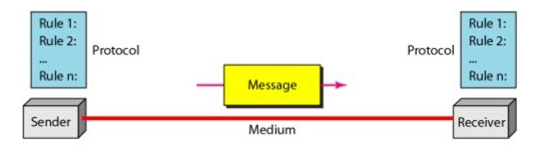


5 components of Networking

Source: Data Communication, Kwangwoon University


I. SENDER (often referred to as 'transmitter') is the party that sends the message.

II. RECEIVER is the party that receives the message.

III. MESSAGE is any data that is been transmitted from sender to receiver.

IV. {MEDIUM, PROTOCOL} often not considered as single entity but it can be because each of them has a relation. The medium (2 types: wired & wireless (will be discussed later in depth)) is the channel that is used and protocol is the set of rules that are defined for that medium. For example, BLUETOOTH falls under the category of wireless MEDIUM but it implements the PROTOCOL of IEEE 802.15. Thus answering HOW the network is functioning.


These 5 components when placed together to form a network, it becomes important to checkout their arrangements and positioning in the network. In technical terms, the schematic representation of the network must also be taken into consideration and this schematic representation, in networking terms is called as TOPOLOGY of the network (topology description in "A-B-C of Networking: Part-3").


*Component: it implies to the entities or the participants involved in the exchange of data


Comments ()


Sign in

Read Next

From Model Mistakes to Metrics

Blog banner

Blockchain technology: security risk and prevention

Blog banner

How to invest in Indian Stock Market ? ~ Tutorial 1

Blog banner

Pipedrive

Blog banner

Data is an asset and it is your responsibility!

Blog banner

Memory management

Blog banner

Explain the concept of ( MIS) Management information systems

Blog banner

5 Stages of Digital Marketing

Blog banner

Direct Memory Access

Blog banner

How to Prepare Your Child for Their First Day of School?

Blog banner

Memory

Blog banner

Proof-of-Stake (PoS)

Blog banner

Security in Cloud Computing

Blog banner

Cache Memory

Blog banner

How International Schools Build Global-Minded Students through Curriculum & Activities

Blog banner

Security in Cloud Computing Environment using cryptography - Rushabh Modi

Blog banner

"Can Lisp do Machine Learning?"

Blog banner

The khan mehtab transforming the modular switches company

Blog banner

Starvation

Blog banner

Explain DBMS in Brief

Blog banner

Famous Indian dishes that where misunderstood to be Indian

Blog banner

Process states

Blog banner

SQL Injection practice on DVWA

Blog banner

Topic: Sessions in Operating system

Blog banner

A buffer overflow

Blog banner

Modern Operating System

Blog banner

Deadlock

Blog banner

Digital Marketing Ethics Transparency Trust And Brand Reputation digital

Blog banner

Big O Notation

Blog banner

BUFFER OVERFLOW_142

Blog banner

Dekkers Algorithm : Ensuring Safe Process Synchronization

Blog banner

Security issues

Blog banner

Patola Outfits for the Modern Wardrobe: Reviving Indian Handloom in Style

Blog banner

Explain Kernel in OS

Blog banner

Does School Infrastructure Really Matter For Learning?

Blog banner

IS CONVERTING AMBITION INTO PROFESSION?

Blog banner

GIS

Blog banner

Threads

Blog banner

Different Types of Data

Blog banner

Layers Of Blockchain

Blog banner

The Memory Hierarchy

Blog banner

Understanding the 4 Types of Learning Methods in Early Childhood

Blog banner