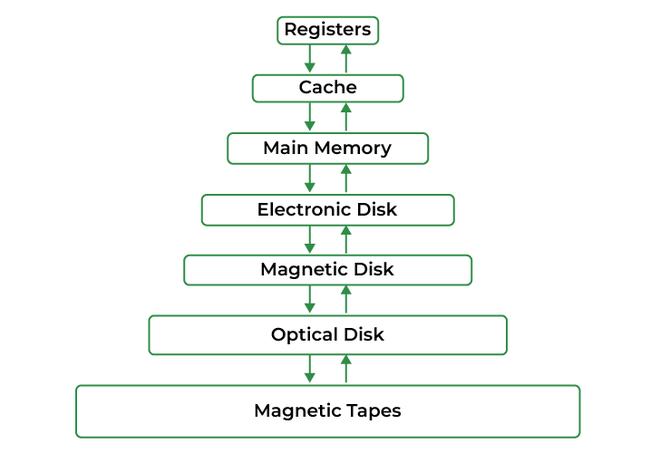
The term memory can be defined as a collection of data in a specific format .The CPU fetches instructions from memory according to the value of the program counter and executes them .
To achieve a degree of multiprogramming and proper utilisation of memory, memory management is important.
Main memory is a repository of rapidly available information shared by the CPU and I/O devices. Main memory is also known as RAM (Random Access Memory).In a multiprogramming computer, the Operating System resides in a part of memory, and the rest is used by multiple processes. The task of subdividing the memory among different processes is called Memory Management. Memory management is a method in the operating system to manage operations between main memory and disk during process execution. The main aim of memory management is to achieve efficient utilization of memory.
Why is Memory Management Required?
Allocate and de-allocate memory before and after process execution.
To keep track of used memory space by processes.
To minimize fragmentation issues.
To proper utilization of main memory.
To maintain data integrity while executing the process.
Static and Dynamic Loading
Loading a process into the main memory is done by a loader. There are two different types of loading :
Static Loading: Static Loading is basically loading the entire program into a fixed address. It requires more memory space.
Dynamic Loading: The entire program and all data of a process must be in physical memory for the process to execute. So, the size of a process is limited to the size of
physical memory.
To gain proper memory utilization, dynamic loading is used. In
dynamic loading
, a routine is not loaded until it is called. All routines are residing on disk in a
relocatable
load format. One of the advantages of dynamic loading is that the unused
routine
is never loaded. This loading is useful when a large amount of code is needed to handle it efficiently.
Static and Dynamic Linking
To perform a linking task a linker is used. A linker is a program that takes one or more object files generated by a compiler and combines them into a single executable file.
Static Linking: In static linking, the linker combines all necessary program modules into a single executable program. So there is no runtime dependency. Some operating systems support only static linking, in which system language libraries are treated like any other object module.
Dynamic Linking: The basic concept of dynamic linking is similar to dynamic loading. In
dynamic linking, “Stub” is included for each appropriate library routine reference. A stub is a small piece of code. When the stub is executed, it checks whether the needed routine is already in memory or not. If not available then the program loads the routine into memory.