wisemonkeys logo
FeedNotificationProfileManage Forms
FeedNotificationSearchSign in
wisemonkeys logo

Blogs

Deadlock

profile
Rishi Chauhan
Aug 14, 2024
0 Likes
0 Discussions
51 Reads

A deadlock in an operating system is a situation where a set of processes become stuck, unable to proceed because each process is waiting for a resource that another process in the same set is holding. Since none of the processes can proceed until another releases its resources, they are in a state of perpetual waiting, leading to a deadlock.

Key Conditions for Deadlock:

A deadlock can occur if the following four conditions hold simultaneously:

  1. Mutual Exclusion: At least one resource must be held in a non-shareable mode, meaning only one process can use the resource at a time.
  2. Hold and Wait: A process holding at least one resource is waiting to acquire additional resources that are currently being held by other processes.
  3. No Preemption: A resource cannot be forcibly removed from a process holding it; it can only be released voluntarily by the process holding it.
  4. Circular Wait: A set of processes exist where each process is waiting for a resource that the next process in the chain holds, forming a circular chain of dependencies.

Example Scenario:

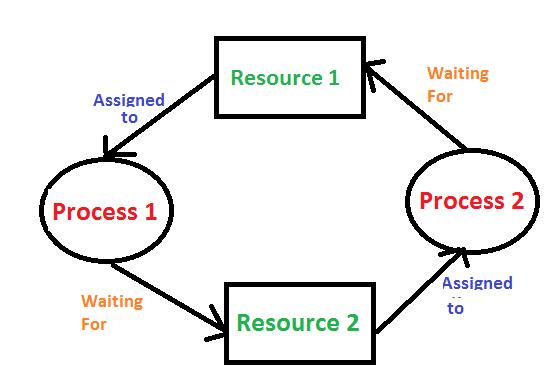
Imagine two processes, P1 and P2, and two resources, R1 and R2. Suppose:

  • P1 holds R1 and requests R2.
  • P2 holds R2 and requests R1.

In this situation, P1 and P2 are waiting on each other to release the resources, leading to a deadlock.

Deadlock Handling Strategies:

Operating systems handle deadlocks using one of the following approaches:

  1. Deadlock Prevention: Ensuring that at least one of the four conditions for deadlock cannot occur.
  2. Deadlock Avoidance: Using algorithms (like the Banker’s algorithm) to ensure that the system never enters an unsafe state where a deadlock might occur.
  3. Deadlock Detection and Recovery: Allowing deadlocks to occur, but the system periodically checks for deadlocks and takes action to recover, such as terminating one or more processes involved in the deadlock.
  4. Ignoring the Problem: Some systems, especially simple ones or those where deadlocks are rare, choose to ignore the problem, hoping that deadlocks will not occur frequently.


Comments ()


Sign in

Read Next

File Management In OS

Blog banner

Apache Kafka

Blog banner

Google

Blog banner

Virtual Memory

Blog banner

Mobile Survey

Blog banner

AI and cyber Security

Blog banner

Challenges of Digital forensics in cloud computing environment

Blog banner

Data Science in Healthcare: Predicting Diseases

Blog banner

Dangers of Using Public WiFis

Blog banner

Introduction to GIS

Blog banner

Mumbai local ......

Blog banner

Exploring Virtual Machines and Computer Forensic Validation Tools

Blog banner

RAID

Blog banner

Women Empowerment

Blog banner

Linux Memory Management

Blog banner

Monday. com App

Blog banner

Binary Search Tree (BST) in Data Structure

Blog banner

Deadlock and Starvation

Blog banner

EMAIL INVESTIGATION

Blog banner

Multiprocessor and Multicore Organization

Blog banner

File Systems in OS.

Blog banner

NodeJs

Blog banner

Instagram Features in 2023 That Will Leave You Stunned!

Blog banner

Payment Card Industry - Data Security Standard PCI-DSS compliance for online banking applications

Blog banner

BASICS OF SHARE MARKET

Blog banner

Modern OS

Blog banner

Have You Explored India Yet?

Blog banner

Hypothesis Testing in Data Science

Blog banner

Digital black market or dark net poses a national security threat?

Blog banner

Unlocking Success: Mastering Google Ads Strategies

Blog banner

My 1stNull Puliya session

Blog banner

How to lose belly fat

Blog banner

Data Science in Healthcare: Predicting Diseases

Blog banner

The Art Of Getting What You Want In Life....

Blog banner

Firewall in Computer Network

Blog banner

Review on Cyber Forensics and its Analysis Tools

Blog banner

Major achievement

Blog banner

Virtual Machine

Blog banner

Different Types of Data

Blog banner

MoSCoW METHOD IN DATA SCIENCE

Blog banner

100 Awesome Keyboard Shortcuts that you didn't knew

Blog banner

What is Data, Information and Knowledge?

Blog banner