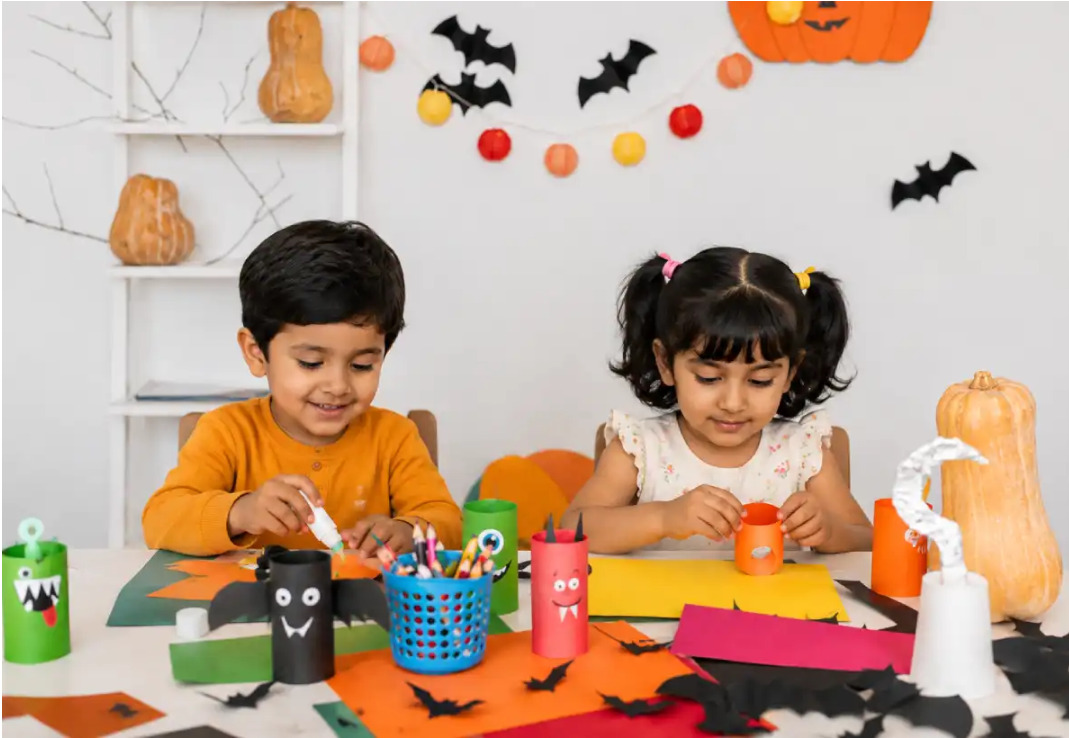
Pretending to be a doctor, a chef, a teacher, a firefighter, or even a superhero is not merely playing games for little kids but also plays a critical role in their education. Pretend play or role-playing gives children a chance to explore the world using their imagination in a fun and secure environment.
Role-playing activities in preschools and daycares are carefully integrated into everyday education. Regardless of whether they run a grocery store, take care of dolls, or act out stories together with other kids, they develop important skills of cognition, socialisation, emotion and communication. This makes pretend play one of the most efficient methods of education during early childhood.
The term pretend play refers to a type of imaginative play in which children make up their own stories, adopt various roles, and employ common household items or toys to act out real-life scenarios. For example, one could use a simple cardboard box as a vehicle, employ building blocks as phones, or pretend to be doctors, teachers, firefighters, and veterinarians tending to animals. Children like to play house, run their own shop or restaurant, dress up, and enact various fairy tales or stories they like. Such fun role-playing activities motivate kids to use their imagination and learn more about the surrounding environment through engaging in play.
Pretend play inspires children to move beyond what is visible to them and make up their own stories, concepts, and games. It is not based on established rules; rather, children create their own characters and situations and learn to find innovative ways to deal with the situations through their own imaginative play. Whether children are using ordinary items to imagine themselves in imaginary situations or performing everyday actions in a pretend way, they engage in innovative thinking by forming ideas and finding various solutions.
Developing Language and Communication Skills
The act of role-playing inherently stimulates children to interact and communicate with each other effectively. Regardless of whether they are acting out roles like serving guests in a restaurant, teaching in a class or attending to patients in a hospital, they learn to speak, listen and convey their ideas confidently. Such pretend activities not only enable the child to increase their vocabulary and sentence structure but also help them to develop good listening skills, questioning abilities, and answering techniques. By having constant conversations in their pretend environment, children become better communicators in the long run.
Learning Social Skills Through Role-Playing
In most cases, pretend play entails children engaging in role-play along with their peers. Through this method, children will learn how to interact in a social environment by cooperating, negotiating and respecting one another as they engage in storytelling and pretend games. Children have the opportunity to share materials, take turns, work as a team and resolve disputes while having fun playing together. Through these interactions, children will be able to develop empathy and establish friendships that will aid in their social growth.
The development of skills through role-playing not only benefits children during their preschool stage but helps them in other areas of life as well. Children who frequently indulge in imaginative play become better learners who can freely express their thoughts and solve problems, along with being cooperative with others. Such play encourages the development of communication skills, creativity, innovation, emotional intelligence, and confidence among other skills, and inspires curiosity and creativity within them.
Pretending is more than just playing a game in the classroom; it is a form of play that not only nurtures creativity and confidence but also helps young minds improve in the areas of communication, emotional intelligence, and problem-solving. By involving themselves in pretend activities, kids who study in Elzee preschool and day care gain many vital skills that they can use in the future in schools and beyond. Preschool plays an important role in every child’s life, allowing them to explore the world and learn various things through play. They can also learn; preschoolers can develop their skills at their own pace.