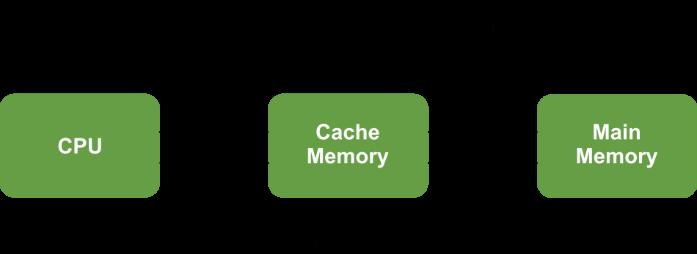
Cache memory is a small, high-speed volatile memory located close to the CPU in a computer system. Its primary purpose is to store frequently accessed data and instructions temporarily, enabling faster data retrieval than would be possible from the main memory (RAM). Cache memory significantly enhances the efficiency and performance of the CPU by reducing the time it takes to access data from the main memory.
Cache memory is a critical component in modern computer architecture, bridging the speed gap between the CPU and main memory. Its strategic location and rapid access capabilities make it indispensable for achieving high performance in computing systems.
There are three types of cache memory:
L1 Cache (Level 1):
L2 Cache (Level 2):
L3 Cache (Level 3):
Functionality of cache memory :
Cache memory operates on the principle of temporal and spatial locality. Temporal locality refers to the tendency of a processor to access the same memory locations repeatedly within a short period. Spatial locality refers to the tendency of a processor to access memory locations that are close to each other within a short period.
When the CPU needs to read or write data, it first checks whether the data is in the cache (cache hit). If the data is found, it is read or written to the cache memory directly, which is much faster than accessing the main memory. If the data is not found in the cache (cache miss), it is retrieved from the main memory and also stored in the cache for future access.
Benefits of Cache Memory :
Techniques of cache mapping :