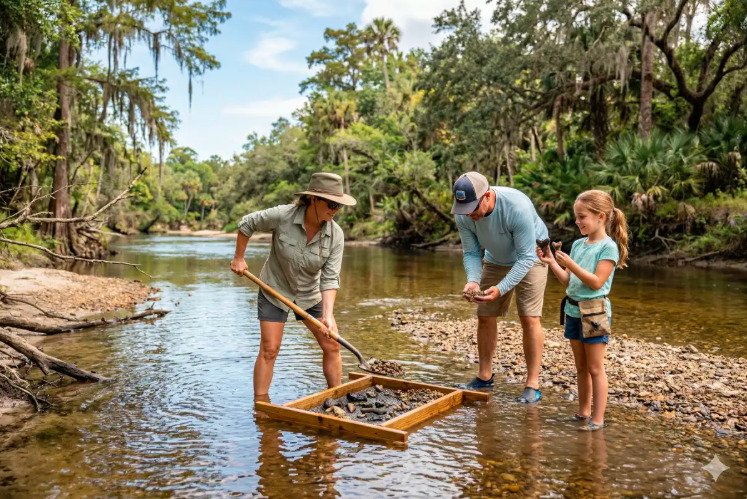
The Peace River, which winds through De Soto County, is world-renowned among paleontologists and hobbyists alike as one of the best places to find Pleistocene and Miocene fossils.
From 10-million-year-old shark teeth to the armour plates of ancient giant armadillos, the river is a literal time machine. If you're ready to get your hands dirty and find a piece of history, here is your beginner’s guide to fossil hunting on the Peace River.
The Peace River was once submerged under a shallow sea, and later, it was home to massive land mammals. This unique history means you can find a mix of marine and terrestrial fossils in the same gravel bed.
Shark Teeth: The most common finds are teeth from Lemon, Bull, and Tiger sharks. If you’re lucky, you might even find the "holy grail": a Megalodon tooth.
Mammal Fossils: Fragments of Mammoth and Mastodon enamel, vertebrae from ancient whales, and the distinct "bumpy" shell fragments of Glyptodonts (giant prehistoric armadillos).
Dugong Ribs: These heavy, stone-like bone fragments are incredibly common and belong to the ancient ancestors of the manatee.
You don't need heavy machinery, but a few specific tools will make your day much more productive:
The Shovel: A long-handled, pointed shovel is best for reaching the gravel layers at the bottom of the river.
The Sifter: This is your most important tool. Most hunters use a floating "screen": a wooden frame with 1/4 inch hardware cloth (mesh).
Fossil Apron or Pouch: You’ll need somewhere to put your treasures so they don’t wash back into the river!
Water Shoes: The riverbed can be rocky and uneven. Protect your feet.
Fossils aren't usually sitting on top of the sand. They are heavy, so they settle into the gravel layers (often called "the bone bed") beneath the sand and silt.
Look for the Inside Bends: Just like gold, fossils tend to accumulate on the inside curves of the river where the current slows down and drops heavy debris.
The Technique: Dig a shovel-full of gravel from the river bottom, dump it into your floating sifter, and shake it at the water’s surface. As the sand washes away, the dark, shiny fossils will begin to reveal themselves among the rocks.
In Florida, you do not need a permit to find shark teeth or shells. However, if you want to keep vertebrate fossils (bones, teeth of land mammals, etc.), you are required to have a Florida Fossil Permit. It costs about $5 and can be applied for through the Florida Museum of Natural History. It’s a small price to pay to stay legal while building your collection!
Timing is everything. Fossil hunting is a dry season activity (typically late October through May). When the river level is low (below 5-6 feet at the Zolfo Springs gauge), the gravel bars become accessible. During the summer rainy season, the water is usually too high and fast to dig safely.
After a long day in the sun and water, there’s nothing better than heading back to the Oak Tree Hotel to wash off the river mud and spread your finds out on a table to identify them. Whether you find a tiny snapper tooth or a massive mammoth molar, you’ll be leaving Arcadia with a souvenir that is millions of years old.
You Might Also Like To Read: A Traveller’s Guide to Offbeat Places in Arcadia, Florida. Explore the historic streets and hidden natural wonders that make Arcadia more than just a pitstop.