Operating system is a interface between computer , user and hardware.
It is a collection odf set of set of programs.
It performs all basic tasks like filr management , memory management , controlling peripheral devices.
It is helpful for the interaction or communication between human and computer.
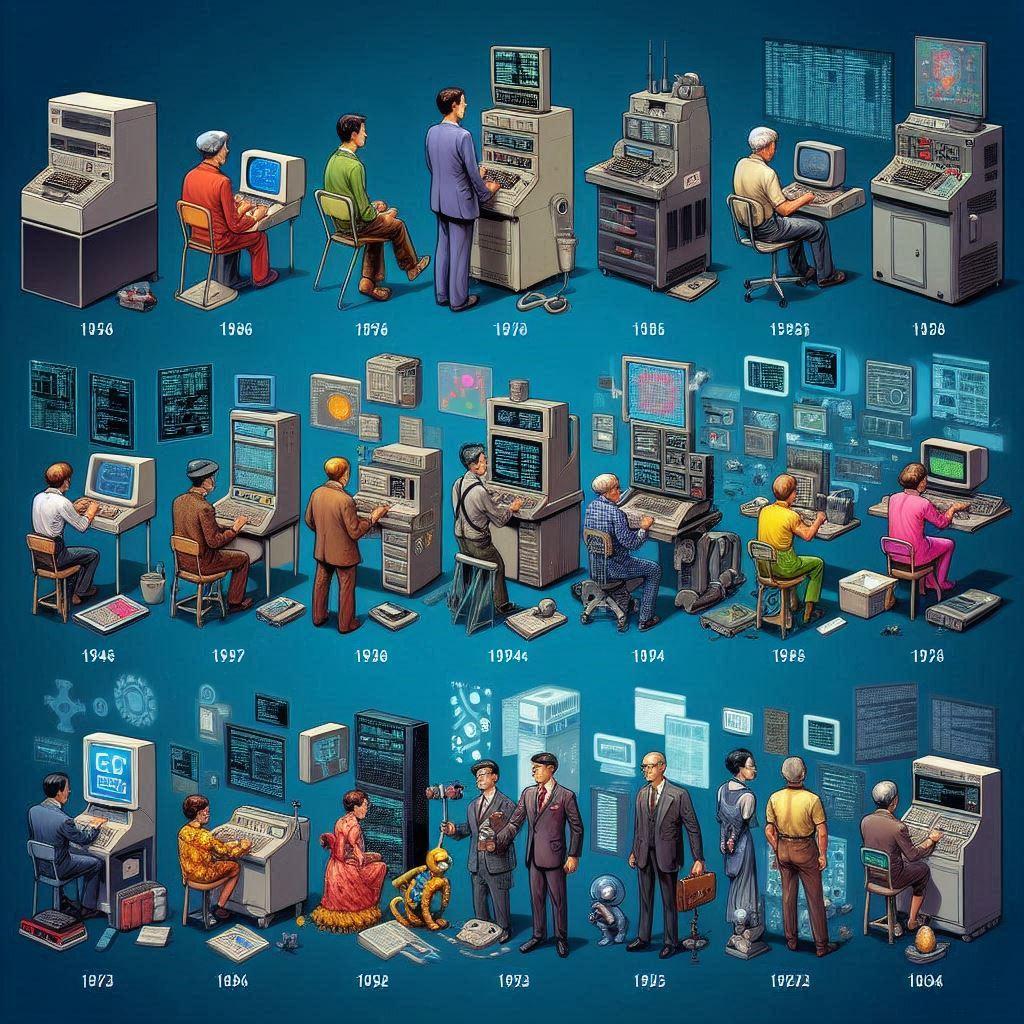
- FIRST GENERATION:-
- It was introduced in 1945 - 1955
- Operating system were not used in this generation only hardware were used.
- In this generation only electronic machines were introduced.
- They used to consume more electricity and used to generate lots of heat.
- This systems were also called as serial processing.
- Hardware like vaccum tubes and play borad were used.
- Example:Electronic Numerical Integrator and Computer(ENIVAC) and UNIVAC-1.
- SECOND GENERATION:-
- It was introduced in 1955-1965
- Batch systems were inctroduced.
- Trasistors were introduced due to this electricity was less used compared to first generation.
- This generation laid the foundation for multitasking.
- While input/output operations processor had to remain idle.
- Example:IBM 1401, IBM 1920, etc.
- THIRD GENERATION:-
- It was introduced in 1965 -1980.
- Multuple users were able to work simultaneously
- One of the feature was multiple programming/multitasking.
- we got feature of online storage for system programs, user program and data, program libraries.
- Integrated circuits (IC's) were used.
- The problem of starvation was overtaken in third generation.
- Example: CDC 1700, IBM-360 Series, etc.
- FOURTH GENERATION:-
- It was introduced in 1980 - now.
- microprocessors and personal computers were introduced.
- Fourth-generation computers utilized microprocessors, which integrated the central processing unit (CPU) into a single silicon chip.
- Rise of conputer networking was seen.
- Fourth generation provides Graphical User Interface(GUI) this is one of the main feature of fourth generation.
- The Graphics User Interface (GUI) technology was used to provide users with better comfort. During this time, PCs became more inexpensive and widespread.
- The processing power, or speed, has skyrocketed.
- This generation of computers had the first “supercomputers” that could perform many calculations accurately also they used networking and higher and more complicated languages as their inputs like C, C+, C++, DBASE.
- The fourth generation of computers contains five separate units and they are input, arithmetic and logic, memory, output, and control units.
- Some fourth generation computers are STAR 1000, CRAY-X-MP(Super Computer), DEC 10, PDP 11, and CRAY-1
- Example:Apple, CRAY-1,etc.
- FIFTH GENERATION:-
- It is primarily based totally on Artificial intelligence (AI) software.
- they aim to mimic hu,an thinking and behaviour, making them fascinating area of research and development.
- Example:PARAM 10000, IBM notebooks, etc.