GEOLOGY AND GEO-TECTONIC FRAME WORK OF WESTERN
BASTAR CRATON
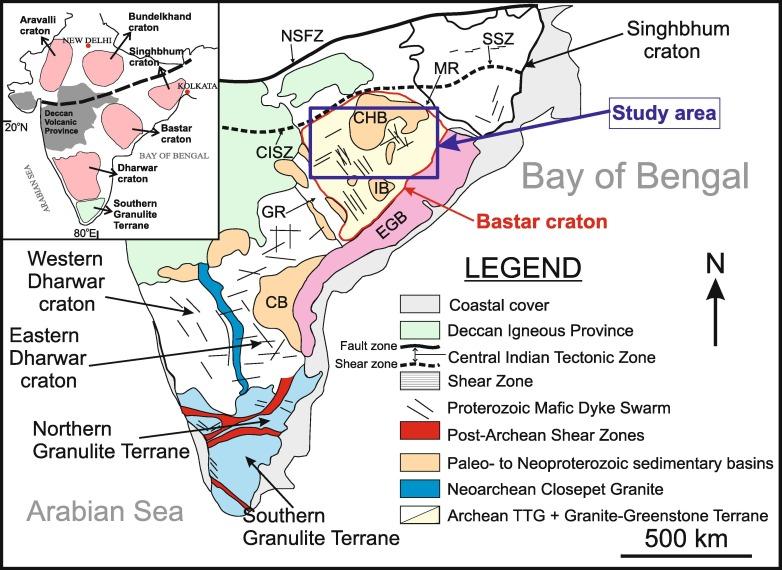
The western part of Bastar Craton exposes Archaean Bengpal and Amgaon gneisses,
Gondpipri Granulite, late Archaean to early Proterozoic Bailadila, Kotri, Dongargarh, Sakoli
group of rocks, Dongargarh granitoids and cover rocks of Pakhal–Sullavai Groups. Younger
cover rocks of Gondwana Sediments and Deccan Basalts are exposed in the south west and west
respectively. The Godavari Graben marks the southern and Satpura Mobile Belt marks the
northern limits of the craton. The plateau basalt of Deccan marks the western limit.
A granulite suite of rocks tentatively named as Gondpipri granulite occurs to the south eastern
margin as a 90 km long 20-40 km wide NW-SE trending belt along the northern flank of
Godavari graben. This forms the probable northwestern extension of Bhopalpatnam Granulite
(2450 ma, Mishra et al.). The Karim Nagar granulite (250 ma, Rb-Sr age, Rajesham et al. 1993)
occurring to the south, across the tectonic join of Godavari graben in the neighbouring Andhra
Pradesh, may probably represent its southern continuity. Tonalite gneisses, pyroxene granulite,
charnockite, mafic-ultramafic complex comprising pyroxenite, norite, gabbro and anorthosite are
the main components of the granulite belt.
The granulite belt in the present area, west of Wainganga, extends in a NE-SW trend, through E-
W, to immediate east of the river as compared to that of its Bhopal – Patnam extension. The N-S
course of Wainganga River is itself a major zone of tectonic discontinuity with profuse fracturing.
The granulite belt abuts against the NNW trending north Godavari lineament, which separates it
from the Pakhal sediments. The northern contact with gneiss/granite also is defined by major
tectonic discontinuities. This high-grade belt is bordered by granites-gneisses and Bengpal-
Bailadila supra crystals to its north. The Bailadila supra crystals comprise metamorphosed basic
volcanics and ultramafic rocks along with banded iron formation, metapelites and quartzites. To
the south, around Surjagarh, thick sequence of these units are exposed extending in a NNW-SSE
direction forming a limb of a major synformal fold which to further north are seen as detached
bands within gneissic rocks. The basic volcanics represented by meta basalts are intimately
associated with garnet - staurolite biotite schists and BIF.
The Bengpal Group with a NW-SE to N-S tectonic grain in the present area comprises medium
grade hornblende gneisses with enclaves of amphibolite, quartzite, BIF etc. and occupies the
northern part of the area and is bordered by Sakoli, Pakhal and Gondwana rocks along tectonic
contacts to the north and west respectively. The Dongargarh granite limits it to the east. The
Amgaon gneissic complex occupying the stretch between Sakoli and Dongargarh supra crystals
composing high grade gneiss supra crystal sequence of gneiss-migmatite, granulites, minor TTG
suite of rocks, amphibolite, meta ultramafites and pre-Sakoli supra crustal assemblages, shows
polyphase tectono-thermal events. Sarkar (1994) has opined that Amgaon Orogenic Belt (2500
ma) is the oldest recognizable intra continental orogeny during Archaean-Proterozoic transition.
CR-022056 4
Narrow linear, BIF bearing volcano-sedimentary litho assemblages at Surjagarh are correctable
with Bailadila Group lying unconformably over the Bengpal Group. It is believed that Bailadila
and its equivalents have developed along major N-S lineament zones. Profuse invasion of mafic -
ultramafic dyke swarms along NW-SE fractures at Surjagarh are undoubtedly lineament
controlled emplacements (not shown in figure).
A metasedimentary sequence dominated by a polymict conglomerate with minor quartzites and
BIF are seen at Wairagarh. This diamondiferous conglomerate with a bizarre clast composition of
gneisses and quartzites of different size in a micaceous groundmass occurs at the southern tip of
Sakoli belt and may represent upper Sakoli or Dongargarh Group as the clasts appear to be
derived from lower Sakoli and adjacent gneisses.
Both Mafic-ultramafic as well as acidic intrusive are emplaced into the craton .The Dongargarh
Granite Batholith present in the central part of the craton and the Mul Granite Pluton located in
the southwestern part of the craton represent the major phase of acid igneous activity.
Petrographically and geochemically the Dongargarh granite shows affinity to 'A' type granites of
shallow level emplacement and includes mainly granitic components (Ramachandra, H. M.
1998). The Dongargarh granite (2465-2270 ma, Rb-Sr age), is considered to be co-magmatic with
felsic volcanics of the Dongargarh Supergroup (Nandgaon felsic volcanics). This emplacement
marks the final phase of the cratonisation process in this part of Central Indian Shield.
The volcano-sedimentary assemblages of N-S trending Kotri – Dongargarh Supergroup have
developed in an intercontinental rift over an Archaean gneissic crust. This shows an
unconformable relation with Sukma Supra crystals to the south. The N-S trending Kotri –
Dongargarh rift zone has been termed as the fundamental zone of weakness developed during
early Precambrian times in Bastar Craton (Ghosh et al., 1992).
The triangular shaped Sakoli supra crystals with a volcano-sedimentary assemblage is also
considered to be formed initially in an intra-continental N-S rift controlled basin, within the AGC
which gradually migrated towards west (Bandyopadhyay et al, 1995). The eastern and
northwestern margin of Sakoli is marked by N-S and ENE-WSW ductile shear zone (Roy et al.,
1992; Roy et al., 1995). The southwestern contact of Sakoli also is a tectonic one. The Sakoli and
Dongargarh Groups are considered to be coeval with respect to their first deformation. It is
considered that Kotri – Dongargarh Mobile Belt and eastern Sakoli ductile shear zone have
evolved from the same family of N-S trending intra plate fundamental crustal zones of weakness
characterized by aborted multiple linear rift systems which controlled the development of
Proterozoic Belts (Bandyopadhyay et al, 1995).
It is clear from the above, that the late Archaean to early Proterozoic mobile belts were developed
on the Archaean gneissic crust along rift related N-S striking fundamental faults through which
voluminous basic and acidic volcano-plutonic materials were emplaced. The development of
major N-S ductile shear zone may suggest repeated re-activation of earlier weak planes. This
ductile shear zone formed during advanced stage of D1 deformation of Sakoli rocks probably
around 1200 ma, a thermal resetting age (D1 of Dongargarh Supergroup) obtained from Bijli
Rhyolite, CR-022056 5
which is considered to be coeval with D1 deformation of Sakoli rocks (Bandyopadhyay, 1995).
The intra-continental extensional sedimentary basins of middle to late Proterozoic/Sullavais are
developed along Godavari graben trending NW-SE to NNW-SSE in the present area. The
initiation of Godavari graben also led to the emplacement of mafic-ultramafic dyke swarms
around Surjagarh, transecting the Bailadila and Dongargarh rocks. The formation of Ghot –
Chamorshi and Bhamragarh lineaments (GC and BL) trending NW-SE parallel to the graben
trend appears to be coeval.
1.1 GEOLOGY OF THE ANDHARI BASINAL AREA: The Andhari basinal area forms the
central part of the western Bastar craton and comprises granulites, gneisses, detached lenses of
Supracrustal elements (equated with Bengpal Group by earlier workers), granites and platformal
cover facies of Pakhal/Sullavai rocks. Granulites comprising acid, intermediate and basic to ultra
basic components are seen in the southern part of the area. The acid granulites are made up of
greasy looking rock consisting essentially of feldspars and quartz (megascopically) and
practically no mafic minerals. These are exposed in nala south of Wadholi. The intermediate
granulites are with 2 pyroxene and plagioclase and are exposed at many places around Gondpipri.
The basic-ultra basic granulites are mainly meta pyroxenite. These bodies generally trend in a
NE-SW direction and comprise dominantly ortho and clino pyroxenes with or without plagioclase
and hornblende. These rocks appear to have been intruded synkinematically with the granulite
facies metamorphism. Under the microscope the basic to ultra basic granulites show a mineral
assemblage of OPX + CPX + Plagioclase (5-10%) + hornblende (retrograded around OPX). The
intermediate have composition OPX + Plagioclase + apatite + biotite + amphibole + carbonate.
Another band is seen in two localities south of Talodhi – Bhangaram and ESE of Ganeshpipri.
These comprise very coarse mega crysts of plagioclase (up to 90%) with minor OPX. Plagioclase
shows alteration to calcite.
Charnockite with meso perthite, plagioclase + quartz + hornblende (retrograded after OPX) are
seen as a major unit in the southern part. These exhibit granoblastic texture (allotriomorphic)
wherein individual minerals are xenoblastic without straight grain boundaries. Good exposures of
Charnockite are seen west, 8 km south and 4 km north of Gondpipri.
Coarse hornblende (20%) bearing gneissic to granulose rocks, seen north of Wadholi upto Ghot –
Chamorshi fault, appear to be probably retrograded intermediate granulite or high grade gneisses
which might have attained very high grade PT conditions during early metamorphic period and
subsequently undergone retrogression. CR-022056 6
Gneisses: These are exposed in the north and northeastern part of the area. Good exposures are
rare and weathered exposures are seen only in nala and canal sections. The gneissic rocks exhibit
frequent compositional variation form sheared grey granite gneiss, hornblende gneiss, and biotite
gneiss to biotite-muscovite gneiss. Pinkish grey gneisses occur locally. The sheared granite
gneisses are seen fringing the Mul granite pluton. Amphibolites, pyroxenite, hornblendite and
gabbroic rocks occur frequently within the gneiss.
The rock is medium to coarse grained and is essentially comprised of quartz, plagioclase
(oligoclase), microcline, biotite and zircon. The hornblende gneisses comprises of quartz,
plagioclase, hornblende and are generally seen close to basic-ultra basic intrusive.
Quartzite and BIF: A number of thin quartzite bands, lensoidal to well ones occur at many areas
trending NW-SE. Occasionally they are ferruginous, fuchsite, with sericite or green diopside. The
ferruginous ones (BIF) are the dominant ones. Occasionally they are sheared and silicified with
sporadic sulphide show. Haematite is the main iron ore in these with good amount of grunerite.
Basic-Ultra basic dykes: Dolerite, gabbro, hornblendite, pyroxenite are the main basic-ultra
basic intrusive of the area. They are concordant to the gneissic foliation and have been subjected
to the later folding and hence show varying trends. These dykes belong to two episodes of
intrusive activity viz. Pre-metamorphic and post-metamorphic. The former are seen as highly
altered bodies such as amphibolite, hornblendite etc., where as the post-deformational ones are
relatively fresh with original igneous textures well preserved.
Vermiculite is noticed in the Asolamendha tank area, exposed in the excavations made by
irrigation authorities. X-ray studies of this have confirmed it to be vermiculite. It occurs as thin
veins of brown micaceous material in gneissic country.
Granite: In the central part of the area circular granite body crops out which are more or less like
a homophonous rock. It is medium to coarse, non-porphyritic rock, having its western boundary
with the Pakhal sediments and acts as the basement for these sediments. Restite patches of
pyroxenite, amphibolite and gneisses are seen occasionally. It is generally comprised of equi-
dimensional quartz, feldspar with minor biotite. Quartz is generally anhedral, and has irregular
sutured grain boundaries and sub-grain development. Plagioclase, tabular in shape has thin twin
lamellas and is albite to oligoclase in composition. K feldspar is Subhedral and shows patchy
alteration to sericite. The plagioclase and K feldspars are almost equal in proportion. Biotite the
main accessory mineral constitutes upto 5%. Zircon and ilmenite form other accessories.
Silicified zones: These are zones of high deformations confined to narrow widths, emplaced by
quartz veins. They generally show brittle deformation with development of brecciation and
cataclasis with vertical movement. These are seen in three major directions viz. N-S, NW-SE,
ENE-WSW and traverse all the rock types. The NW-SE ones are the most prominent ones and are
seen for considerable strikes lengths. Some of these shear zones host mineralisation such as
Copper and Barium e.g. Thanewasna CR-022056 7
zone, North Godavari fractures zone and Ghot – Chamorshi zone. The sheared rocks have
distinct colours depending upon the rocks they are traversing. These zones also correspond to
the major lineaments of the area. The quartz veins in these are emplaced along multiple
fractures showing anatomizing pattern. The reactivation of these zones is manifested in the
form of repeated silicification and deformation with development of pseudo-tachylite.