About an OS:
An is a program that manages the computer hardware. It
also provides a basis for application programs and acts as an intermediary between the computer user and the computer hardware. An amazing aspect of operating systems is how varied they are in accomplishing these tasks.
Process of an OS:
An active program which running now on the Operating System is known as the process. The Process is the base of all computing things. Although process is relatively similar to the computer code but, the method is not the same as computer code. A process is a present entity, in contrast to the program, which is sometimes thought of as some sort of a non-active entity. The properties that the process holds include the state of the hardware, the RAM, the CPU, and other attributes. All multiprogramming operating systems, from single-user systems such as Windows for end users to mainframe systems such as IBM’s mainframe operating system, z/OS, which can support thousands of users, are built around the concept of the
process.
Process Description:
The OS controls events within the computer system. It schedules and dispatches processes for execution by the processor, allocates resources to processes, and responds to requests by user processes for basic services. Fundamentally, we can think of the OS as that entity that manages the use of system resources by processes.
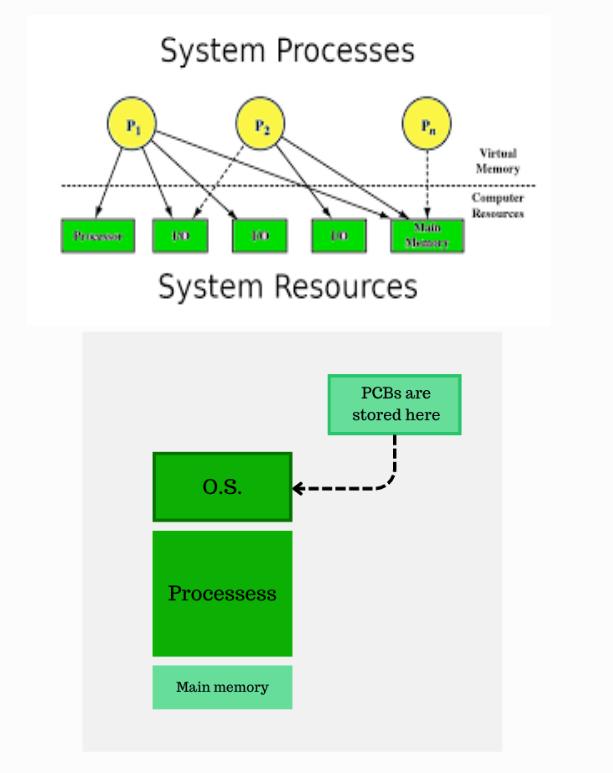
If there are number of processes (P 1 ,…, P n ) that have been created and exist in virtual memory. Each process, during the course of its execution, needs access to certain system resources, including the processor, I/O devices, and main memory.
process P 1 is running; at least part of the process is in main memory, and it has control of two I/O devices. Process P 2 is also in main memory but is blocked waiting for an I/O device allocated to P 1 .
Process Control of an OS:
In OS the process control block is a data structure which is very essential.Each process control block contains all
of the information about a process that is needed by the OS.
The blocks are read and/or modified by virtually every module in the OS, including those involved with scheduling, resource allocation, interrupt processing, and performance monitoring and analysis. One can say that the set of process control blocks defines the state of
the OS.This brings up an important design issue.
A number of routines within the OS will need access to information in process control blocks. The provision of direct access to these tables is not difficult. Each process is equipped with a unique ID, and this can be used as an index into a table of pointers to the process control blocks.
The difficulty is not access but rather protection.