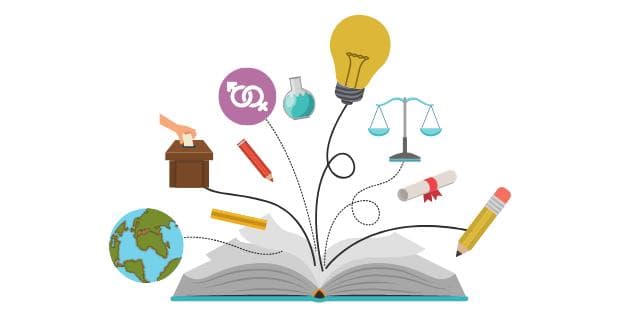
In today’s highly competitive and ever-evolving global scenario, it means a whole lot more to prepare one’s child for higher studies than to merely help him/her secure decent grades. In today’s academia around the world, one expects self-assured, self-reliant thinkers who can think and act, as well as adapt to the ever-evolving environment. The role of international schools in this context becomes highly positive. They encourage their young achievers with a globally aligned curriculum, new-age teaching methodologies, as well as a learning experience encompassing every aspect of a student’s development.
The international schools abide by global school curricula such as Cambridge, IB, and other international curricula that emphasise not only learning but also developing an understanding at a profound level. Internationally, these schools encourage questioning, analysis, research, and critical thinking. The subjects connect with reality so that learners can grasp how things apply outside of the text material. This is exactly how education at the university level needs to be. Here, learners not only retain information but also learn to think and articulate their ideas with confidence, making them adapt effortlessly to university-level education.
They want students who can think out of the box, and that is just what an international school nurtures. Each of them offers dynamic learning environments through interesting questions, exploring new ideas, project work, discussions, debates, research work, and inquiry-based learning. They learn to evaluate information rather than blindly accepting it. They develop solid logical reasoning, analyse real-life situations, and come up with some innovative solutions. By the time they go to college, they are quite at ease with presentations, research work, teamwork, and independent learning — all qualities necessary in higher education.
Building confidence is always required in higher education, be it speaking out in seminars, presenting ideas, writing research papers, or teamwork in peer groups. The international schools teach the students communication skills from a very young age. The students are encouraged to participate in class discussions, presentations, performances, debate competitions, Model United Nations, and other educational activities that help the students speak out confidently, present their ideas confidently, tolerate other people’s ideas, and participate in group conversations. The activities ensure that the students gain the required confidence to perform well in college interviews, teamwork, or other interactions in college.
Success, apart from academic success, is related to the intelligence and qualities of the students. Most international schools have various activities for personal development. The students are involved in different activities such as leadership training programs, student counselling, community service, sports, team building activities, environmental projects, and other group activities. These enable the students to inculcate qualities like leadership qualities, sense of responsibility, sense of discipline, empathy, sense of respect for others, or sense of strength or emotional strength. Possessing such qualities, the students are confident about handling their independence, difficulties, or college responsibilities successfully.
Harshad Valia International School is a shining example of how international schools enhance the upbringing of competent, confident, emotionally well-balanced, and globally competent individuals. This provides a favourable ground for building world-class competencies such as critical thinking, communication, cultural competence, and responsibility among children, preparing them well for education as well as for life that exists after that. This kind of dynamic school provides an opportunity for empowering and achieving within the backdrop of a global world.