Digital Marketing budgets have been rising for years and are soon expected to take over entire marketing budgets. This boost in Digital Marketing budgets highlights the utilization of digital advertising services for both small and big organizations.
The key to flourishing here is to have not only a robust but also a sustainable strategy behind each digital marketing campaign to make sure that resources are utilized effectively.
It’s like trying to shoot a bull’s eye in the dark when you put resources on a social media campaign targeted to the wrong audience set.
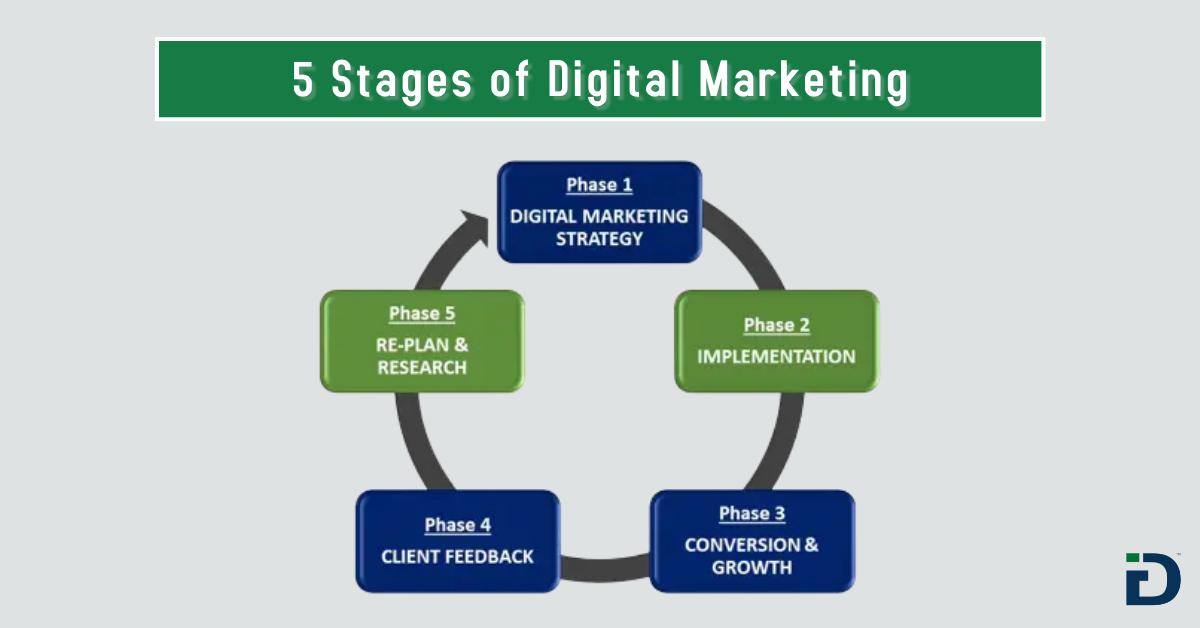
The below-mentioned 5 Stages of Digital Marketing are applied for creating a strategy that targets holistic business goals.
Phase 1: Setting up A Digital Marketing Strategy:
The first stage of the digital marketing lifecycle begins with a strategy in mind. Only when you know you want to boost footfalls/sales or increase brand awareness you will work towards achieving it. Now the next step is asking your core team some questions. How will we reach these set goals? How much budget we will require to achieve this? Your team will then chalk down a strategy that they think will work. Post this your team should be encouraged to find loopholes in the strategy and also assess the challenges that they are likely to encounter.
Your brainstorming meetings should have answers to these questions:
- Who is your target audience?
- What is your product/service USP?
- What customer challenge are you solving?
- On which social media platform you will find your audience/potential buyers?
- How are you going to measure campaign success or failure?
- What content tone will be acceptable to your audience set?
The main objective to get answers to these questions is to help you channelise your resources. These answers will not only help you generate working content but also design a marketing strategy based on this information that supports various channels to reach your goals.
Before you move to the next phase you should have the foundation of a digital marketing strategy that is customised to achieve specific set goals.
Phase 2: Implementation:
The first stage can be a time-consuming task as it involves a lot of conceptualizing which will ensure a smooth transition to the 2nd phase.
The core of phase 2 is to build a relationship with your target audience while collecting as much data as possible through analytics. This collected data will soon begin to paint the picture for your brand on how your target audience is reacting to your branding on various channels you have chosen to communicate. It should be your ultimate aim to channelise all your digital marketing efforts into creating and sustaining a healthy relationship with your target audience. We recommend you utilise personal client-engaging tactics to achieve this.
Additionally, it is vital to ask them their perspective about your products or services. Top it up with what they would like to see improvements in your product. The motto of this phase is to boost client interaction and engagement.
Phase 3: Conversion and Growth:
Commonly, a company runs a digital marketing campaign to convert its potential customers (your target audience) into actual buying customers. You begin with a warm-up where you give company information, brand information and brand values (if any) and then you strike when the iron is hot. After engaging your target audience for some time, you need to strike when the iron is still hot. This phase offers you an opportunity to elevate a client into the next consumer lifecycle.
Depending on your business goal be it increasing your sales or boosting brand loyalty, or booking more patients at your clinic — this is when you must strike for heavy conversions. A great medium to increase your customer base is by making them know the solution you offer to their problem or challenge. Most brands use customized mail or advertisements to your potential buyer list. Recently, referral programs have been gaining momentum to expand the already existing customer database.
Alongside conversion, you also need to pause and reflect on how fruitful your digital marketing campaign has been. Skim through all the data at your disposal, analyze it keenly and make decisions based on your findings.
Phase 4: Client Feedback:
By this phase, you already know if your digital marketing campaign worked well or not for you. If in case it did not work for you, do not get disheartened, look for loopholes and fill in the gaps. On the other hand, If your campaign achieved the pre-defined goals, do not let it get to your head instead try to make it perfect.
As mentioned above, the data you collect can paint a big picture of what your customers actually desire. Pay attention to where they are dropping off in your conversion timeline, what channels are most successful, and any messaging that seems to particularly appeal to your target audience. You may also infer that most of your conversions happened over social media platforms and not through email marketing. We advise you to look at the scenario as a whole and put more resources behind social campaigns with high effectiveness.
This is the perfect time to reach out to your buyers directly and ask them what they like. Do it via a feedback form or also a simple small survey to garage their levels of interest.
Phase 5: Re-plan and Research:
This stage is mostly considered a data analytics stage as by now you have collected some great data from your audience as well as from your buyers. It’s finally the time to allow your data to make sense for you. This data will not only help you fill gaps in your digital marketing strategy but will help you design a win-win campaign for both brand and buyers.
You may want to join the dots between phase 1 and phase 5 of The Digital Marketing Lifecycle. This is your opportunity to relook at all the elements that are responsible to make a social media campaign succeed. According to the data gathered adjust your strategy and better fine-tune it for better future results.
Escalate Your Digital Presence
Since the digital world relies completely on technology, which is continuously progressive, this is also your time to look for the latest digital marketing trends in 2022 and evolve with them. These 5 phases work in continuation i.e. once phase 5 is over you again move to phase 1 where you can alter, add, and subtract elements from the digital marketing campaign that will fend you better results.