wisemonkeys logo
FeedNotificationProfileManage Forms
FeedNotificationSearchSign in
wisemonkeys logo

Blogs

differentiate thinking humanly and rationally

profile
Batman Vengeance
Jan 03, 2025
0 Likes
0 Discussions
465 Reads

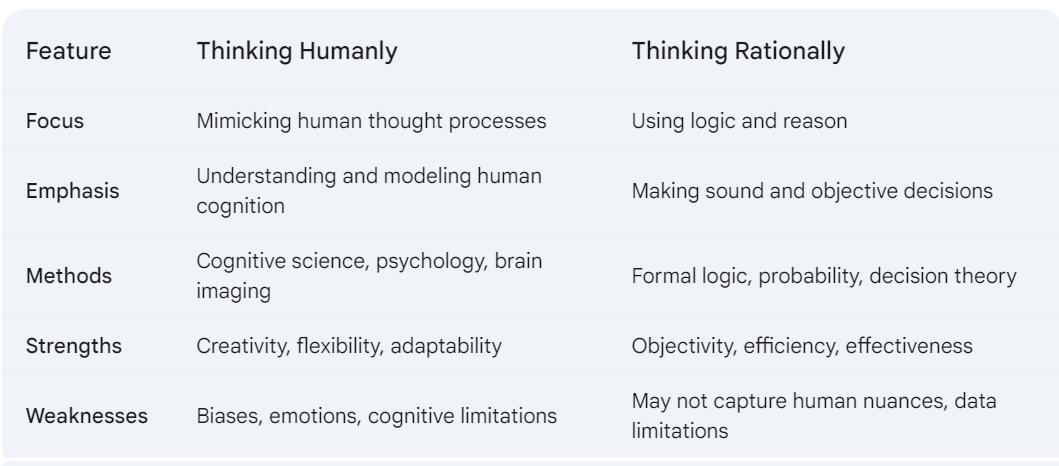
Thinking Humanly:


Focus: Mimicking the cognitive processes of the human mind.  

Methods:

Cognitive Science: Studies how humans perceive, learn, remember, and reason.  

Psychological Experiments: Observe human behavior in various situations to understand how they think and make decisions.  

Brain Imaging: Analyze brain activity to understand the neural mechanisms underlying human thought.  

Goal: To create artificial intelligence systems that can think and behave like humans, including:

Understanding human language: Natural Language Processing (NLP)  

Learning and adapting: Machine learning, deep learning  

Solving problems creatively:

Limitations:

Human thinking is complex and not fully understood.  

Can be influenced by biases, emotions, and cognitive limitations.  

Thinking Rationally:


Focus: Using logic, reason, and evidence to make sound judgments and decisions.  

Methods:

Formal Logic: Uses symbols and rules to represent and manipulate information.  

Probability and Statistics: To deal with uncertainty and make informed decisions.  

Decision Theory: Provides frameworks for making optimal choices under various conditions.  

Goal: To create artificial intelligence systems that can:

Make objective and unbiased decisions.

Solve problems efficiently and effectively.

Learn and adapt based on evidence.

Limitations:

May not always capture the nuances of human reasoning, such as intuition and creativity.

Can be limited by the availability and quality of data.


Comments ()


Sign in

Read Next

Top 5 Post-Wedding Skin Care Tips

Blog banner

Cherish the Craft — Essential Tips to Maintain Your Patola Collection

Blog banner

Smartsheet

Blog banner

Security requirements for Safe E-Payments

Blog banner

Computer Forensics and its Impact in Business Environment

Blog banner

Proof-of-Stake (PoS)

Blog banner

Cache memory

Blog banner

Understanding Endometriosis and Its Psychological Impact on Quality of Life

Blog banner

How to Find the Right Therapist For Me?

Blog banner

OS Assignment 1

Blog banner

The Role of Fibre in Everyday Nutrition and Digestive Health

Blog banner

CRISP-DM Methodology

Blog banner

Incident management in ITSM

Blog banner

Music

Blog banner

Evolution of Operating system

Blog banner

SEIZING DIGITL EVIDENCE AT THE SCENE

Blog banner

Disk Management

Blog banner

1.1 basic elements

Blog banner

ACHIEVEMENTS IN OPERATING SYSTEMS

Blog banner

City2Surf & Spring Fitness Recovery Guide: How Sports Drinks Silently Damage Enamel

Blog banner

RAID_142

Blog banner

MD5 Collisions and the impact on computer forensics

Blog banner

FOMO Fear of Missing Out: When Comparison Steals Your Peace of Mind

Blog banner

Deadlock and Starvation

Blog banner

(Input/Output) in os

Blog banner

How to kiss

Blog banner

10 Amazing facts about Tokyo Ghoul

Blog banner

Volatile Memory & Non-Volatile Memory Explained

Blog banner

Is Brushing After Eating Damaging Your Teeth? (Fact or Myth)

Blog banner

My Favorite Sportsperson

Blog banner

Memory Management

Blog banner

Process in OS

Blog banner

Classification Vs Clustring? What's the diffrence?

Blog banner

Earth with no trees

Blog banner

OPERATING SYSTEM

Blog banner

Teenagers of Today

Blog banner

Data Security and Data Privacy in Data Science

Blog banner

Kernel Memory Allocation In Linux.

Blog banner

Fault Tolerance in an Operating System

Blog banner

Data Lake

Blog banner

Why Data Security Is Important

Blog banner

Concurrency:Deadlock and Starvation

Blog banner