wisemonkeys logo
FeedNotificationProfile
FeedNotificationSearchSign in
wisemonkeys logo

Blogs

File Allocation Methods

profile
Maitry Gala
Sep 09, 2024
0 Likes
0 Discussions
314 Reads

File Allocation Methods in Operating Systems

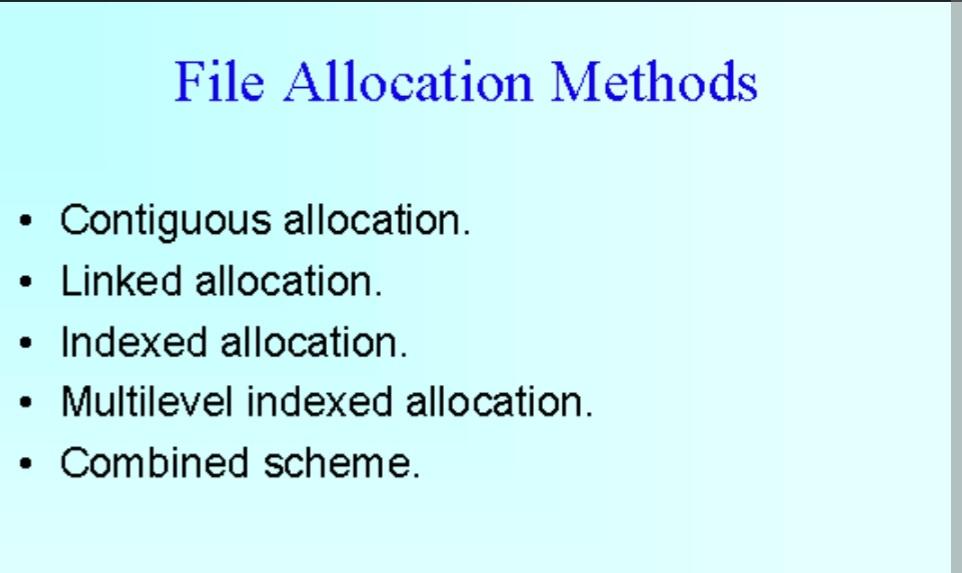
File allocation methods determine how data blocks of a file are mapped to storage devices. The choice of method can significantly impact factors such as disk space utilization, file access speed, and system performance. Here are some common methods:


1. Contiguous Allocation

All blocks of a file are allocated in contiguous blocks on the disk.


Advantages:

  1. Efficient for sequential access.
  2. Simple to implement.

Disadvantages:

  1. Fragmentation (internal and external) can occur, leading to wasted space.
  2. File size must be known in advance.
  3. Difficult to grow or shrink files.


2. Linked Allocation

Each block contains a pointer to the next block in the file.


Advantages:

  1. Flexible file size.
  2. No fragmentation.

Disadvantages:

  1. Inefficient for sequential access (multiple disk seeks).
  2. Loss of a pointer can result in data loss.


3. Indexed Allocation

separate block (index block) stores pointers to the blocks of a file.


Advantages:

  1. Efficient for both sequential and random access.
  2. No fragmentation.
  3. Flexible file size.

Disadvantages:

  1. Requires additional space for the index block.
  2. Can be inefficient for very large files.


4. Extents-Based Allocation

A combination of contiguous and indexed allocation. A file is divided into extents (contiguous blocks), and an index block stores pointers to these extents.


Advantages:

  1. Efficient for both sequential and random access.
  2. Reduces the number of index entries compared to indexed allocation.

Disadvantages:

  1. Requires additional space for the index block.
  2. Can be inefficient for very large files.


5. Allocation on Demand

Blocks are allocated as needed when data is written to the file.


Advantages:

  1. Efficient for small files.
  2. No wasted space for unused blocks.

Disadvantages:

  1. Can be inefficient for large files.
  2. Requires more complex allocation algorithms.

Modern operating systems often use a combination of these methods, such as a hybrid of indexed and extent-based allocation, to optimize performance and efficiency.


Maitry Gala --53003230041 Div A


Comments ()


Sign in

Read Next

Guidelines for a Low sodium Diet.

Blog banner

The Right way of cooking

Blog banner

Fitness

Blog banner

What is Anxiety? How to manage Anxiety?

Blog banner

Tomato Butter Sauce with Bucatini

Blog banner

ART AND CULTURE OF VRINDAVAN

Blog banner

Fudgy Tahini Date Chocolate Bars

Blog banner

Super Garlicky Tomato Soup with Smashed White Beans

Blog banner